Building a great app is the starting point — getting it discovered, downloaded, and turned into a habit is the actual challenge. The app stores are home to millions of competing products, organic discovery is harder than it’s ever been, and the average app loses 77% of its users within three days of download. App marketing in practice means solving three distinct problems simultaneously: discovery (how do people find you?), conversion (why do they download?), and retention (why do they come back?). These 41 ideas cover all three, with practical guidance on what actually moves the needle.
1. Invest Seriously in App Store Optimisation
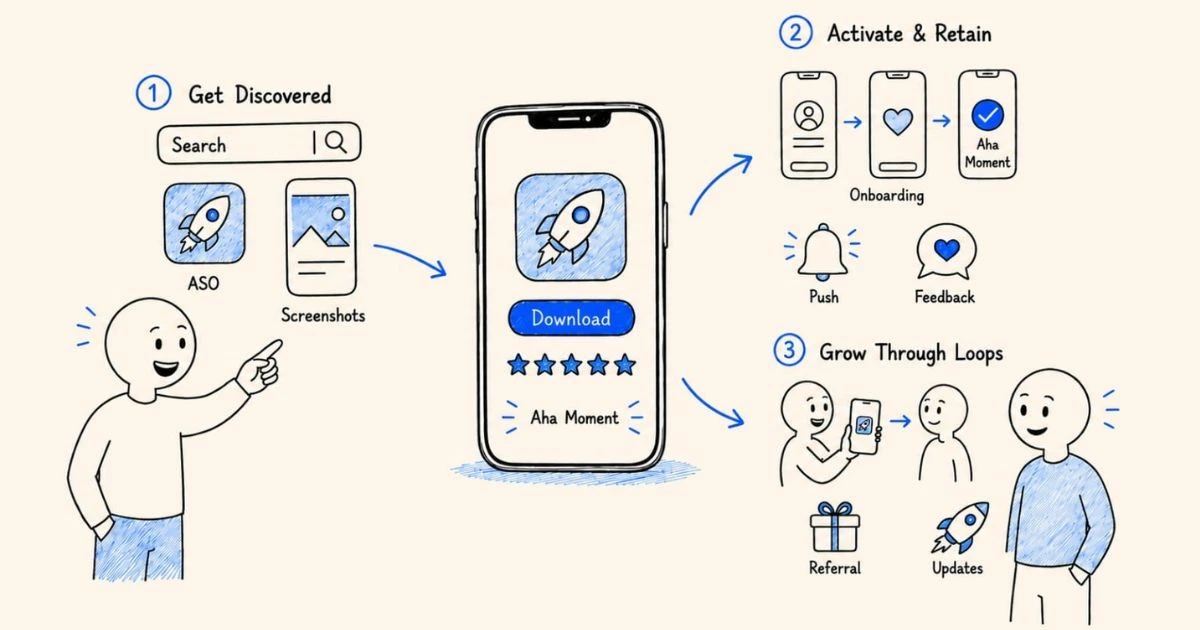
App Store Optimisation is the closest thing to SEO for mobile — the discipline of making your app rank higher and convert better in the App Store and Google Play. Optimise your app title and subtitle with your primary keyword. Write a description that leads with the strongest user benefit in the first three lines (before “Read More” is clicked). Use all available keyword fields strategically. A/B test your screenshots, icon, and short description. Update your store listing every time you ship a significant feature. ASO is ongoing, not a one-time task — the apps that maintain consistently strong organic download volumes treat it as a permanent marketing function.
2. Design an Icon That Communicates the App’s Purpose Instantly
The app icon is your first and often only chance to make an impression in search results and on a user’s home screen. A distinctive, purpose-communicating icon that stands out in your category significantly increases conversion from browse to download. Test multiple icon variants against each other using the App Store’s product page optimisation tools. The icon design decisions that perform best are usually not the most complex — simplicity, contrast, and a single clear visual metaphor consistently outperform detailed or cluttered designs. Treat the icon as serious brand work, not a developer afterthought.
3. Capture Screenshots That Tell a Story, Not Just Show Screens
Most apps waste their screenshot slots with interface screenshots that show what the app looks like rather than what it does for the user. Screenshots with device frames and bold headline text — “find a doctor in 60 seconds,” “never miss a bill payment,” “your entire portfolio, one tap away” — communicate the value proposition before a user reads a single word of your description. Design each screenshot to answer a specific benefit question, tell the story of the user’s journey from problem to solution, and make each image capable of standing alone as a reason to download. High-quality screenshots are consistently the highest-converting improvement available in an ASO audit.
4. Create a Preview Video That Demonstrates Value in the First Three Seconds
An App Store preview video auto-plays without sound in the store listing. The first three seconds — before a user can swipe past — need to communicate the app’s core value through visual demonstration alone. Show the app doing something impressive, solving a recognisable problem, or delivering an outcome that creates immediate desire. Keep the video under thirty seconds. The apps with the highest conversion rates from listing view to download almost universally have a well-produced preview video that demonstrates the product clearly and compellingly in the critical first moments of attention.
5. Build a Landing Page That Converts Paid Traffic to Downloads
A dedicated app landing page — separate from a corporate website — with a clear value proposition, screenshots, a demo video, press coverage, ratings and reviews, and direct links to both store listings is essential for any paid acquisition campaign. Traffic sent to an App Store listing that doesn’t have context about why the app exists converts at lower rates than traffic sent to a well-designed landing page that builds conviction before the click to download. Optimise the page for mobile, load time, and conversion — treat it with the same rigour as you’d apply to any direct-response landing page.
6. Get Featured on Product Hunt
A successful Product Hunt launch generates significant first-day download volume, press attention, and early user feedback from a tech-savvy, influencer-dense audience. The preparation matters: build a community before launch day, engage with the Product Hunt community genuinely in the weeks before, prepare a genuine maker story, and have supporters ready to upvote and comment during the first hours. A top-ten ranking on launch day generates thousands of downloads and the kind of tech press mentions that are difficult to achieve through conventional PR. For B2B and productivity apps especially, a Product Hunt launch is one of the highest-ROI distribution moments available.
7. Reach Out to App Review Sites and Tech Journalists
App review publications — AppAdvice, 148Apps, Android Authority — and tech journalists at mainstream outlets actively cover new and notable apps. A personal, concise pitch with a promo code, a clear explanation of what the app does differently, and a genuine story angle (the problem it solves, who built it and why) generates the kind of independent reviews that drive sustained organic downloads. Build a press list of ten to fifteen relevant reviewers and journalists, personalise your pitch to each, and make the review experience as easy as possible. Editorial coverage in respected app review publications drives download spikes that compound into long-term store ranking improvements.
8. Build a Content Marketing Programme Around Your Core Use Case
Users who discover your app through content — a blog post answering the question your app solves, a YouTube video demonstrating the problem and the solution — arrive with far higher intent and better retention than those who download through an ad. Build a content programme around the specific problems and interests of your target user: if your app helps freelancers track time, write the definitive content about freelance time management. If it helps runners train, write genuinely useful content about training programmes. Content-acquired users have consistently better activation rates, lower churn, and higher lifetime value than paid-acquired users across most app categories.
9. Launch a Referral Programme With In-App Incentives
Referral programmes have built significant user bases in competitive app categories — Dropbox’s extra storage for referrals is the canonical example. An in-app referral mechanic that gives both the referrer and the referred user something genuinely valuable — premium features, extended trial, in-app currency, storage, or capability — creates a viral distribution loop that costs less per acquired user than almost any paid channel. Keep the referral flow simple: one tap to share, a clear explanation of the benefit, and an easy redemption path for the new user. Track referral cohort retention separately — referred users who arrive through a trusted recommendation consistently outperform paid-acquired users on every retention metric.
10. Use Push Notifications Strategically, Not Just Frequently
Push notification strategy is as much a retention marketing discipline as any campaign. Users who receive too many irrelevant notifications disable them or delete the app. A push notification strategy built around genuine user-triggered value — a notification that’s personalised, timely, and directly relevant to something the user has already done in the app — retains permission and drives re-engagement. Build a notification taxonomy: transactional notifications (always send), behavioural notifications (based on specific in-app actions), and engagement notifications (triggered by inactivity, sent sparingly). Test every notification type for its impact on both short-term re-engagement and long-term retention.
11. Create an Onboarding Flow That Reaches the “Aha Moment” Immediately
The most important marketing investment for most apps is not user acquisition — it’s the onboarding experience that converts a new download into an activated, retained user. Identify the single moment when a new user first experiences your app’s core value — that “aha moment” where the product makes sense. Every step of onboarding should point directly toward that moment as quickly as possible. Remove every unnecessary step, permission request, and question between installation and value delivery. Apps that reach the aha moment within the first session retain users at dramatically higher rates than those that ask users to complete long setup flows before delivering any value.
12. Build In-App Channels for Collecting User Feedback
Users who feel heard are more loyal and more likely to leave positive reviews. Build feedback mechanisms into the app experience: a post-session rating prompt triggered at the right moment, an in-app feedback channel, and visible acknowledgement when reported issues are fixed. The reviews and ratings that result from users who feel the team listens to them are substantially more positive than those generated by automated generic review prompts. App store ratings are a direct ranking signal — apps that improve their rating from 3.8 to 4.5 experience measurable improvements in organic download volume from the same store visibility.
13. Run Apple Search Ads and Google UAC Campaigns
Apple Search Ads and Google’s Universal App Campaigns are purpose-built for app user acquisition and integrate directly with App Store and Google Play conversion tracking. Apple Search Ads in particular — which appear at the top of App Store search results for keyword-targeted queries — consistently deliver high-quality users with lower churn than most other paid channels because the user is in the App Store actively searching. Start with exact-match campaigns on your own brand terms to protect against competitor poaching, then expand to category and problem-oriented keywords. Measure against D7 and D30 retention rates, not just cost per install.
14. Partner With Complementary Apps for Cross-Promotion
Other apps whose users overlap with your target audience but don’t compete directly are natural cross-promotion partners. A fitness tracking app and a nutrition app serve the same user. A productivity app and a meditation app target the same professional. Cross-promotion — in-app placements, newsletter features, or co-created content — reaches a pre-qualified audience at a fraction of the cost of paid acquisition. Identify five to ten complementary apps in your ecosystem and approach the developers directly with a specific, mutual partnership proposal. Cross-promotion deals cost nothing but the creative and the relationship, and they deliver users who’ve already demonstrated the behaviour patterns that predict success with your app.
15. Build a Community Around Your App’s Core Interest
Apps that build communities — a Slack group, a Discord server, a Reddit community, a Facebook group — around the interest or activity they serve create a retention mechanism that operates independently of the app itself. Community members support each other, generate user content, provide product feedback, and become genuine advocates who recruit new users organically. The community also provides a direct communication channel that doesn’t depend on push notification permissions or email open rates. Apps with strong communities consistently report better long-term retention rates than comparable apps without community, across almost every category.
16. Create Tutorial and How-To Content for YouTube
Users searching YouTube for “how to [something your app helps with]” are discovering apps through tutorial content every day. A YouTube channel with genuine how-to content — both showing how to use your app and addressing the broader topic area your app serves — generates sustained organic discovery and improves activation rates for users who arrive having already learned how the product works. Tutorial videos also reduce support burden by answering common questions before they become tickets. Invest in one well-produced tutorial video per month and build a searchable library over time. YouTube is the second-largest search engine in the world; apps that ignore it are missing a major discovery channel.
17. Build a Solid Email Onboarding Sequence for New Users
Email remains one of the highest-retention marketing channels for apps, particularly for web-onboarded users or apps with a web companion. A well-designed email onboarding sequence — welcome on day one, tips on day three, feature spotlight on day seven, re-engagement at day fourteen — keeps users connected to the value of the app during the critical first two weeks when most churn occurs. Personalise the sequence based on what the user did or didn’t do in the first session. Email sequences built around user behaviour (sent when a user completes their first action, or when they haven’t returned after three days) outperform time-based sequences on every engagement metric.
18. Use Influencer Marketing on Platforms Where Your Users Spend Time
Influencer marketing for apps works best when the influencer already uses a product like yours and can demonstrate it authentically to an audience that cares about the use case. A productivity influencer on YouTube who genuinely uses your task management app. A fitness creator who logs their workouts using your tracker. A language learner on TikTok who shows their daily practice session in your app. The integration of the product into content the influencer was already making is far more credible than a scripted mention. Identify five to ten creators whose content naturally intersects with your app’s use case and build genuine partnerships rather than transactional placements.
19. Implement Deep Linking to Improve Paid Campaign Performance
Deep links — URLs that take a user directly to a specific screen within your app rather than the home screen — dramatically improve the conversion and retention performance of paid acquisition campaigns. A user who clicks an ad for a specific feature and is taken directly to that feature has a far better first experience than one who is deposited on a generic home screen with no context. Implement deep linking across your paid campaigns, email communications, push notifications, and referral flows. The improvement in activation rates from campaign-specific deep links is typically significant enough to meaningfully change the economics of your paid acquisition channels.
20. Get Reviewed by Newsletter Curators in Your Category
Category-specific newsletters — productivity tool roundups, indie app newsletters, design tool digests, developer tool recommendations — have small but highly engaged audiences of exactly the users most likely to download and retain your app. A single mention in the right newsletter can generate hundreds of high-quality downloads from users who are actively looking for new tools. Build a list of curated newsletters in your category and approach the writers personally with a genuine pitch and a free premium account. Newsletter audiences are typically smaller than social audiences but convert at dramatically higher rates.
21. Participate in Relevant Online Communities Where Your Users Gather
Reddit communities, Facebook groups, Discord servers, LinkedIn groups, and Slack communities relevant to your app’s use case are full of potential users who are actively discussing the problems your app solves. Genuine participation — answering questions, providing useful information, engaging with community discussions without promotional intent — builds brand awareness and trust that converts to downloads when community members become aware of your product naturally. The developers who build genuine reputations in relevant communities consistently generate more organic downloads from those communities than those who participate only for promotional purposes.
22. Build a Freemium Model That Markets the Premium Tier Through Usage
A well-designed freemium model is itself a marketing strategy. Free users who experience genuine value in the core product and encounter premium features at exactly the moment they need them convert to paid at dramatically higher rates than those who hit hard paywalls before experiencing value. Design the free tier to be genuinely useful — enough value to generate habit and loyalty — and the premium tier to be the natural next step for users who’ve engaged deeply with the free experience. Users who upgrade from free to paid have lower churn rates and higher lifetime value than those acquired directly into a paid product because they’ve already demonstrated genuine engagement.
23. Monitor and Respond to Every App Store Review
App Store and Google Play reviews are a public marketing channel. A developer who responds thoughtfully to every review — thanking positive reviewers, addressing negative ones with empathy and a genuine fix plan — signals to the thousands of prospective users who read those reviews that the team behind the app is attentive and cares about the user experience. Both platforms display your response directly beneath the review. Critical reviews that receive a professional, helpful response often result in the reviewer updating their rating. Build a weekly review monitoring habit and respond to every review within 48 hours.
24. Create a Waitlist or Beta Programme for New Features
A waitlist or beta programme for significant new features serves multiple marketing functions simultaneously. It creates anticipation and exclusivity around what’s coming. It generates a motivated cohort of early testers who provide high-quality feedback. And it creates an announcement moment — “we’ve opened the beta” and then “the feature is now live to all” — that provides two content opportunities from a single product development cycle. Market the beta programme through email, social media, and in-app notifications. Beta participants who’ve invested in shaping a feature become advocates for it when it launches and generate the authentic word-of-mouth that drives organic discovery.
25. Use Cohort Analysis to Identify and Fix Your Biggest Retention Drops
Retention analysis — looking at what percentage of users from each acquisition cohort are still active at day one, day seven, day thirty, and day ninety — is the most important diagnostic tool for identifying where your user journey is breaking down. If you lose 60% of users before day three, the problem is onboarding. If you lose them between day seven and day thirty, the problem is habit formation. If you lose them at renewal, the problem is perceived value. Identifying the specific drop point allows you to focus product and marketing investment on the problem that will have the greatest impact on lifetime value. No other single analytical practice creates more return on improvement effort.
26. Launch on Multiple Platforms Simultaneously for Maximum Visibility
Launching on both iOS and Android simultaneously — even if one platform is initially more polished than the other — captures more of your total addressable market and prevents the competitive window that a platform-exclusive launch provides. Many of the most effective app launch strategies also include a web or desktop companion at launch, allowing users who discover the app through content or search to begin using it on any device. Multi-platform presence from day one also ensures that press coverage and influencer mentions reach the broadest possible audience rather than excluding a significant proportion of prospective users.
27. Build a Transparent Product Roadmap and Share It Publicly
A public product roadmap — showing what you’re building, what’s coming next, and what you’ve already shipped — converts three audiences simultaneously: prospective users who want the features you’re planning, current users who feel invested in the product’s direction, and lapsed users who return when they see a feature they’ve been waiting for. Tools like Canny, Trello, or a simple dedicated page allow users to upvote requests and see how their input shapes the product. Public roadmaps also generate media attention when significant features ship, providing a news hook with every major release rather than only at launch.
28. Run Limited-Time Promotions to Test Price Sensitivity and Drive Volume
For paid apps or those with premium tiers, a limited-time promotional price serves multiple purposes: it generates a spike in downloads that improves store ranking, it captures price-sensitive users who will eventually see enough value to upgrade, and it provides data on the price elasticity of your specific market. Run promotions at strategic moments — around a major feature launch, during relevant awareness moments in your category, or at end-of-year when app purchases spike. Measure the quality of promotion cohorts against regular-price cohorts: if promotion users retain equally well, the volume and ranking benefit justifies the lower revenue per user.
29. Use In-App Events on the App Store to Drive Visibility
Apple’s App Store supports In-App Events — feature launches, challenges, competitions, and live events that appear as cards in the App Store search results and on your product page. In-App Events are a free incremental discovery mechanism that gives your app additional store visibility during the event period. They’re particularly effective for games, fitness apps, learning apps, and any app with community or competitive mechanics. Schedule In-App Events around significant product moments — a new challenge, a content drop, a community event — and treat each one as a mini-launch with a complete App Store creative package.
30. Build a Growth Hacking Function Focused on Viral Loops
The apps that grow fastest are those with viral loops built into the product itself — mechanisms through which using the app naturally generates new user exposure. Sharing a result, inviting a collaborator, sending content created in the app, or competing on a public leaderboard each represents an in-product viral mechanic. Review your app’s core value proposition and identify where natural sharing behaviour could be engineered or amplified. A viral coefficient above 1.0 — where each user generates more than one new user — creates exponential growth that no paid acquisition budget can replicate. Building for virality is product work, not just marketing work, but marketing owns the incentive design.
31. Localise Your App and ASO for International Markets
Localisation — genuine translation and cultural adaptation of your app, store listing, and marketing materials — dramatically increases conversion and retention in international markets compared to English-only products. The App Store and Google Play weight store listing localisation in search results for non-English searches, meaning a localised listing ranks better in those markets immediately. Prioritise markets where your category has strong demand, where English-language alternatives are limited, and where the economics of localisation payback quickly. Start with one or two markets and localise completely — product, store listing, support resources, and push notifications — rather than partially localising across many.
32. Create a Podcast or Appear as a Guest on Relevant Podcasts
Podcast appearances — either as a guest on shows your target users listen to, or as the host of a podcast about the topic your app addresses — generate the kind of personal brand awareness and trust that drives high-quality downloads from engaged audiences. Podcast listeners convert at far higher rates than most digital ad audiences because they’ve spent twenty to sixty minutes hearing from you and have self-selected as interested in the topic. Identify ten to fifteen podcasts in your category with audiences that match your target user and pitch a genuine story — your own journey, a specific insight about the problem your app solves, or a research finding relevant to your space.
33. Build a Retention Dashboard and Review It Weekly
Retention is the most important marketing metric for any app business, but most app teams monitor acquisition metrics more closely than retention metrics. Build a retention dashboard that shows D1, D7, D30, and D90 retention for every acquisition cohort, broken down by channel, geography, device, and user segment. Review it weekly with the full product and marketing team. The channels delivering the highest acquisition volume are often not those delivering the best retained users. A channel that delivers 500 downloads per week with 40% D30 retention is more valuable than one delivering 2,000 downloads per week with 8% D30 retention. Let retention data drive channel allocation decisions.
34. Use SMS and WhatsApp for High-Stakes Re-Engagement
For apps where a user becoming inactive represents significant consequence — a health app where lapsed users may be missing medication reminders, a language learning app where daily practice makes the difference — SMS or WhatsApp re-engagement can recover inactive users at dramatically higher rates than email or push notifications. SMS and WhatsApp open rates exceed 90%. Use these channels sparingly and for genuine value moments rather than promotional messages. A personalised “we noticed you haven’t logged in — here’s what you’ve been working toward” WhatsApp message to a lapsed user who opted into this communication recovers a meaningful proportion of churned users who wouldn’t respond to any other channel.
35. Partner With Corporate Clients for B2B Distribution
Many apps that began as consumer products have significant B2B distribution potential — employers who provide the app to employees, enterprise licences for productivity tools, or corporate wellness programmes that use consumer health apps. The B2B channel acquires users in volume with lower per-user acquisition costs and better retention rates, because corporate-sponsored adoption creates institutional commitment that individual downloads don’t. Build a simple enterprise landing page, develop a case study from any existing business users, and approach HR departments and employee benefits teams directly with a tailored commercial proposal. B2B distribution often unlocks scale that consumer-only models take years to achieve.
36. Run A/B Tests on Every Major Marketing Asset
App store screenshots, onboarding copy, push notification language, paywall design, and landing page layouts all benefit from systematic A/B testing. The App Store and Google Play both provide built-in A/B testing tools for store listing elements. Firebase and third-party tools allow in-app testing. The discipline of testing every significant marketing element — running one test at a time, with sufficient volume for statistical significance, and acting on results — compounds into measurable improvement in conversion rates across the entire funnel. Teams that test systematically outperform those that optimise by intuition, often dramatically, because the intuitions of product teams are frequently wrong about what real users respond to.
37. Build a Strong Social Proof Stack Before Your Launch
Users downloading an app for the first time look for evidence that others have found it valuable: review ratings, number of downloads, press coverage logos, named user testimonials, and social proof from people who look like them. Before your public launch, build this social proof stack deliberately: run a closed beta to generate genuine early reviews, secure press coverage with one or two respected publications, collect video testimonials from beta users, and ensure your store rating starts above 4.0. An app that launches with visible social proof converts at significantly higher rates from day one than one that launches cold and asks early users to trust it without evidence.
38. Develop an Affiliate Programme for Review Sites and Tool Directories
Review sites, tool directories, and comparison platforms that recommend apps generate high-intent organic traffic from users who are actively researching solutions. An affiliate programme that rewards these publishers for converting recommendations to downloads or subscriptions incentivises them to feature your app prominently and to update their coverage as you ship new features. Identify the top five to ten directories and review sites in your category, reach out to their editorial or partnerships teams, and build affiliate relationships with a fair commission structure. Affiliate-generated users typically have better retention than ad-generated users because they arrive pre-informed about the product’s capabilities.
39. Tell Your Founding Story Authentically
The story of why your app exists — the problem the founder experienced, the gap in the market they identified, the years of iteration before the product worked — is marketing content that no competitor can replicate. Tell it on your about page, in your product hunt bio, in podcast interviews, in press pitches, and in social media content. Founders who are visibly present in their product’s marketing generate higher brand trust than those who remain invisible. Users who understand why a product was built feel a relationship with it that increases loyalty and advocacy. Authentic founding stories in particular resonate with early adopters who are often looking for a product to believe in, not just a utility to use.
40. Use App Clips and Instant Apps to Reduce Trial Friction
App Clips (iOS) and Instant Apps (Android) allow users to experience a core feature of your app without installing it — triggered by an NFC tag, a QR code, a Safari banner, or a smart app banner. For apps where the core value can be demonstrated in a single focused interaction, App Clips and Instant Apps dramatically reduce the barrier to trial and increase conversion to full install among users who experience genuine value in the clip experience. They’re particularly powerful for apps tied to physical locations or objects — a restaurant ordering app, a parking payment tool, an event guide — where the trigger context perfectly matches the user’s immediate need.
41. Treat Every Update as a Marketing Moment
App update releases are underused as marketing events. Each update represents an opportunity: a changelog that’s written for users rather than developers, an in-app notification celebrating what’s new, an email to your user base highlighting improvements, and — for significant releases — a press outreach with a specific story angle. The App Store and Google Play surface recently updated apps more prominently in certain browse contexts. Users who receive update notifications and see meaningful changes are more likely to re-engage and leave positive ratings. Building a marketing cadence around your release schedule transforms what is often treated as operational maintenance into a sustained, regular audience engagement opportunity.