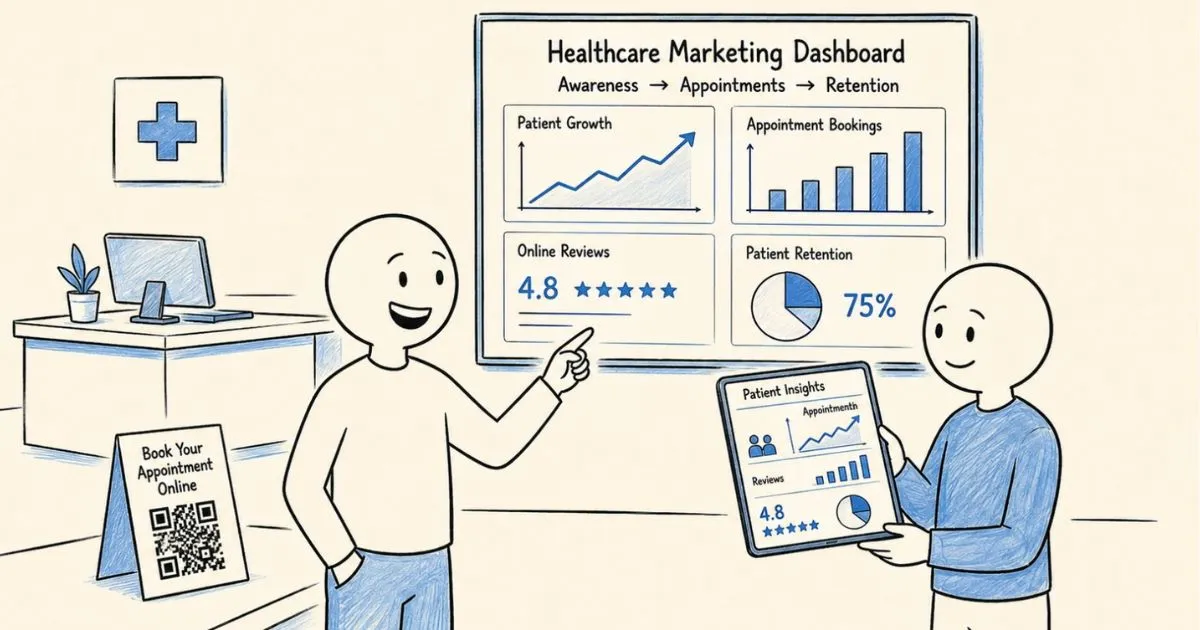
Healthcare marketing operates under unique constraints: patients are making decisions that affect their physical wellbeing, regulatory requirements govern what can be claimed and how, and the trust required before someone chooses a healthcare provider is deeper than in almost any other category. Yet healthcare providers who fail to market effectively leave patients unable to find the help they need. Effective healthcare marketing isn’t about persuasion — it’s about being findable, being trustworthy, and making the path to care as clear and accessible as possible. These 34 ideas are designed for clinics, independent practitioners, healthcare brands, and health-focused service businesses navigating this balance.
1. Optimise Your Google Business Profile for Local Patient Searches
Patients searching for a GP, physiotherapist, dentist, or specialist in their area begin their search on Google. A fully optimised Google Business Profile — with your address, phone number, opening hours, accepted insurance, specialities, and a compelling description — ensures you appear prominently when those searches happen. Upload photos of your clinic environment, your team, and your reception area. Enable booking links where your booking system allows. Collect and respond to Google reviews consistently. For healthcare providers with a physical location, the Google Business Profile is often the highest-return single marketing action available, generating patient enquiries at zero ongoing cost.
2. Create Patient Education Content That Ranks in Search
Patients research symptoms, conditions, treatments, and procedures on Google before and after seeking professional care. A content programme that provides genuine, accurate, accessible patient education — “what to expect from a first physiotherapy session,” “when to see a specialist for back pain,” “how does a dental implant procedure work?” — attracts patients at the research phase and positions your practice as the knowledgeable, trustworthy provider they call when ready to book. All health content must be accurate, appropriately caveated, and reviewed by a qualified practitioner before publication. Well-produced health education content generates sustained organic search traffic and builds credibility simultaneously.
3. Build a Strong Review Profile on Google and Relevant Health Platforms
Patient reviews on Google, Doctify, iWantGreatCare, Trustpilot, and NHS friends and family tools are among the most influential factors in a prospective patient’s provider choice. A systematic review generation process — prompting patients to leave a review after a positive interaction, via email, text, or a card given at the end of an appointment — builds the review volume and recency that improve search ranking and patient conversion. Respond professionally and empathetically to every review, never sharing patient-identifiable information in the public response. Healthcare providers with strong review profiles on multiple platforms consistently attract more new patients than equivalent providers with few or poorly rated reviews.
4. Ensure Your Website Is Mobile-Optimised and Fast
The majority of healthcare searches happen on mobile devices, often by patients experiencing symptoms or seeking urgent information. A website that loads slowly, is difficult to navigate on a phone, or buries the appointment booking path generates patient frustration and lost bookings. Audit your website for mobile usability, page speed, and the clarity of your primary call to action — booking an appointment or calling — from every entry point. A patient in discomfort who can’t find your phone number or booking form within five seconds will leave and search elsewhere. Website performance is infrastructure, not marketing, but it determines the effectiveness of every other channel that drives traffic to your site.
5. Use Email to Maintain Patient Relationships Between Appointments
Patients who receive relevant, useful communication between appointments are more likely to maintain their healthcare engagement, return for follow-up care, and recommend your practice to family and friends. A monthly patient email — health tips relevant to your speciality, seasonal health reminders, practice news, and information about new services or practitioners — keeps your practice front-of-mind and demonstrates ongoing care for patient wellbeing beyond the appointment. Ensure all email communications comply with GDPR and your information governance obligations. Patient emails that provide genuine health value generate higher open rates and more positive patient relationships than those that focus purely on appointment reminders and promotional content.
6. Build a Clear, Patient-Friendly Online Booking System
Friction in the appointment booking process is one of the primary reasons patients don’t follow through with seeking care. An online booking system that shows real-time availability, allows appointment type selection, provides clear confirmation and reminders, and works smoothly on mobile reduces the barrier between a patient’s decision to seek care and an actual appointment on the books. Patients who book online are more likely to attend their appointment (they’ve taken an active step) and more likely to return (they’ve experienced the convenience). Display your online booking option prominently on every page of your website and in your Google Business Profile.
7. Invest in Video to Explain Treatments and Reassure Nervous Patients
Healthcare anxiety is a real barrier to care. A prospective patient who is nervous about a procedure is far more likely to book if they can watch a short video that shows exactly what will happen, meets the practitioner who will treat them, and addresses common fears with honesty and warmth. A video library of treatment explanations — “what happens during an MRI scan,” “what to expect from your first osteopathy appointment,” “the dental implant procedure step by step” — reduces pre-appointment anxiety, improves show rates, and builds the trust that converts enquiry to booking. Short-form videos on social media also build the practitioner’s personal brand with prospective patients who haven’t yet reached the booking stage.
8. Develop a Strong Referral Network With Other Healthcare Professionals
GP referrals, physiotherapy to orthopaedics, dentist to oral surgeon, optometrist to ophthalmologist — healthcare is built on professional referral networks. Building strong relationships with the practitioners who are most likely to refer patients to your speciality generates a consistent stream of warm, referred patients who arrive with professional endorsement and specific clinical need. Introduce yourself personally to GPs, practice managers, and other relevant professionals in your area. Ensure your referral process is as smooth as possible: easy referral letters, prompt appointment availability for referred patients, and timely clinical communication back to the referring professional. Professional reputation in healthcare compounds through referral relationships over a career.
9. Participate in Local Health Events and Community Wellbeing Initiatives
Health fairs, community wellbeing events, corporate health days, and local charity initiatives provide access to large audiences of people interested in their health in an informal, non-clinical context. A well-presented practitioner who can offer a free health check, answer questions, or provide useful health information at a community event builds the kind of personal recognition and trust that drives bookings from the local community. These events also generate press coverage from local media who cover health and community stories. Being visibly present in your community’s health conversation positions your practice as a genuine local health asset rather than simply a clinical service provider.
10. Build a Social Media Presence Around Patient Education, Not Self-Promotion
Healthcare social media performs best when it’s genuinely educational and useful rather than promotional. Instagram posts explaining the difference between two treatment options. A TikTok demonstrating a simple mobility exercise for desk workers. A LinkedIn article from your team’s specialist on the research behind a new treatment protocol. Content that helps your target patient audience understand their health and the options available to them attracts engaged followers who are pre-educated on your speciality when they come to enquire. Avoid making clinical claims on social media that aren’t supported by evidence, and ensure all clinical content is reviewed for accuracy before posting.
11. Invest in Local SEO to Dominate Your Catchment Area
Local SEO — the practice of optimising your online presence to rank for geographically specific healthcare searches — is the highest-return digital marketing activity for most healthcare providers. A physiotherapy clinic that ranks first for “physiotherapy in [your town]” receives dramatically more enquiries than one on page two. Key local SEO activities: consistent NAP (name, address, phone) information across all platforms, local keyword optimisation on your website, Google Business Profile optimisation, local backlink building (from local medical directories, community organisations, and press coverage), and consistent review generation. Local SEO compounds over time — a well-optimised local presence in healthcare becomes more dominant with each passing month as citations and reviews accumulate.
12. Create a Newsletter for Healthcare Professionals Who Refer to You
A quarterly newsletter for referring healthcare professionals — covering clinical updates relevant to your speciality, changes to your service offering, referral pathway information, and relevant research summaries — maintains your relationship with referrers between personal contact moments. Referring professionals who feel kept informed and respected by the specialists they refer to continue to refer with confidence. The newsletter is also a mechanism for communicating any expansion of your service offering — a new specialist joining, a new diagnostic capability, an evening clinic for working patients — to the referral network most likely to act on that information.
13. Publish Condition-Specific Guides Targeting High-Value Patient Searches
Patients searching for specific conditions — “knee pain treatment options,” “anxiety treatment without medication,” “back pain specialist near me” — are expressing clinical need that your practice may be able to address. Condition-specific guides on your website — written at an accessible patient level, medically accurate, and with a clear next step to seek professional assessment — attract exactly these searches organically. Optimise each guide for the specific condition terms your target patients use. A website with condition-specific content pages consistently generates more patient enquiries per visitor than a generic “about us and our services” site, because it speaks directly to what the patient is experiencing.
14. Use Google Ads to Capture High-Intent Patient Searches
Patients searching Google for “[your speciality] near me” or “[specific condition] specialist in [your area]” are in an active care-seeking state — among the highest-intent audiences in any marketing context. Google Ads targeting these searches, with ad copy that addresses the patient’s concern directly and a landing page focused on booking rather than general information, generates patient enquiries at a predictable and measurable cost. Healthcare advertising must comply with ASA and MHRA guidelines — no unsubstantiated health claims, appropriate caveats, and no use of patient testimonials in certain regulated areas. Work within these constraints carefully; the campaigns that perform best in healthcare advertising are those built on honest, specific, and appropriately evidenced communication.
15. Build a Frequently Asked Questions Resource That Reduces Pre-Appointment Anxiety
The questions patients have before their first appointment — what to wear, what to bring, how long it will take, whether it will hurt, what the practitioner will need to know — are predictable and answerable. A comprehensive FAQ page on your website addresses these questions before they become barriers to booking. Patients who arrive at an appointment knowing what to expect are calmer, more prepared, and more satisfied with the experience than those who arrive anxious and uninformed. A well-designed FAQ resource also generates organic search traffic from patients researching procedures and reduces the volume of administrative questions your reception team handles daily.
16. Develop a Patient Recall System for Preventive and Follow-Up Care
Patients who are due for a follow-up appointment, an annual check, a routine screening, or a treatment review often need a prompt to book — not because they don’t value their health but because life is busy and healthcare scheduling is easy to defer. A systematic patient recall system — automated reminders sent by text, email, or letter at the appropriate clinical interval — increases appointment attendance and continuity of care while generating predictable revenue for the practice. Recall systems are as much a patient care mechanism as a marketing one: patients whose ongoing health management is actively supported by their provider have better clinical outcomes and higher satisfaction than those who must manage all their own healthcare scheduling.
17. Be Active in Professional Associations and Healthcare Networks
Membership and active participation in professional associations — the RCGP, BMA, relevant specialist societies, and healthcare leadership networks — builds the professional credibility and referral relationships that generate sustained practice growth. Presenting at professional conferences, contributing to association publications, serving on committees, and engaging with CPD in your field signals to colleagues that you are a trusted, current, and engaged practitioner. In healthcare, professional reputation is the foundation of referral relationships, and referral relationships are the most reliable source of high-quality, well-matched patient flow for most specialist practices.
18. Use Patient Satisfaction Surveys to Improve and to Generate Marketing Insights
A structured patient satisfaction survey — sent within 48 hours of an appointment — captures feedback at the moment of clearest recollection and provides the operational and marketing data needed to continuously improve the patient experience. Use validated patient satisfaction measurement tools (Friends and Family Test, Patient Experience Questionnaires) and supplement with specific questions about what patients valued most and what could be improved. High satisfaction scores, shared appropriately and within regulatory guidelines, become marketing assets. Patterns of feedback reveal the service elements most important to patients and most worth emphasising in your marketing communications.
19. Create Dedicated Marketing for Corporate and Occupational Health Services
Many healthcare providers offer — or could offer — occupational health services, corporate wellbeing programmes, or employee health clinics. The market for employer-purchased healthcare is significant and growing, and B2B healthcare marketing reaches this audience through entirely different channels than consumer patient marketing. Develop a dedicated corporate health offer and market it directly to HR directors, employee benefits managers, and occupational health buyers at local and regional employers. LinkedIn, direct outreach, and corporate HR publications are the primary channels. Corporate healthcare contracts generate high-volume, consistent revenue streams and reduce the patient acquisition cost relative to individual patient marketing.
20. Partner With Gyms, Wellness Centres, and Health-Adjacent Businesses
Gyms, yoga studios, Pilates centres, health food retailers, and wellness spas serve customers who are actively invested in their health and who represent excellent prospective patients for preventive and elective healthcare services. Referral partnerships with these businesses — a physiotherapy clinic partnered with local gyms, a nutritional therapist partnered with a health food retailer, a sports medicine practitioner partnered with an athletics club — generate patient referrals from audiences who are already health-motivated. These partnerships are often mutually beneficial: both businesses can recommend each other with confidence because their clients genuinely overlap and the recommendation serves the client’s health interests.
21. Invest in a Professional Podcast or Appear on Health Podcasts
Health podcasts have large, engaged audiences of people who prioritise their health and actively seek expert knowledge. Appearing as a guest on established health podcasts — or building your own — generates the kind of in-depth expert credibility that brief social media posts cannot establish. A twenty-minute podcast conversation about your speciality, your approach to patient care, and the evidence behind your treatment philosophy demonstrates expertise and personality to an audience that has self-selected as interested in health. Podcast listeners convert at higher rates than most digital advertising audiences because they’ve chosen to spend extended time with the speaker’s ideas before any commercial interaction occurs.
22. Develop an Accessible Private Pay Fee Structure and Market It Transparently
For private healthcare providers, transparent and accessible fee structures — clearly displayed on your website, with an explanation of what’s included and what patients can expect — reduce the price uncertainty that prevents many patients from enquiring about private care. A patient who has to call to find out costs often doesn’t call at all. Display fees clearly, explain any additional costs that might arise, and communicate the value patients receive alongside the cost. Private healthcare providers who communicate fees transparently consistently generate higher enquiry volumes and higher conversion rates than those who require a conversation before disclosing any pricing information.
23. Use LinkedIn to Build Your Professional Reputation in Your Speciality
LinkedIn is where healthcare professionals, commissioners, referring practitioners, and healthcare industry decision-makers spend professional time. A consistent LinkedIn presence — clinical commentary, research summaries, professional insights, and engagement with industry discussions — builds the professional reputation that generates both referral relationships and speaking invitations, media enquiries, and partnership opportunities. Healthcare professionals with active LinkedIn profiles receive significantly more unsolicited professional approaches and opportunities than those who are professionally invisible on the platform. This is particularly valuable for clinicians developing portfolio careers that include clinical work, education, research, or advisory roles.
24. Create a Symptom Checker or Self-Assessment Tool on Your Website
A genuinely useful clinical self-assessment tool — “is this the right time to see a physiotherapist about your back pain?”, “do these symptoms suggest you might benefit from a hearing test?” — engages patients at the research and self-assessment stage, before they’ve decided whether to seek professional care. A well-designed tool provides genuine value (helping patients understand their situation) while naturally progressing to a booking CTA where the assessment suggests professional evaluation would be helpful. These tools generate organic search traffic from symptom-related searches, reduce inappropriate enquiries (patients who self-assess as not yet needing care), and improve conversion from enquiry to appointment for those who do proceed.
25. Build a Marketing Strategy for New Practitioner Recruitment That Reflects Your Culture
For growing practices, recruiting quality practitioners is a function that benefits significantly from the same marketing discipline applied to patient acquisition. A clearly articulated employer brand — what it’s like to work at your practice, the clinical values, the professional development opportunities, the culture — attracts practitioners whose values align with yours and reduces the time and cost of finding good clinical staff. Publish your culture explicitly: on a dedicated “join our team” page, in sector-specific job advertising, and on professional social media. Practices that are known as excellent places to practice attract clinical talent proactively rather than competing purely on compensation.
26. Offer Free Initial Consultations for Appropriate Services
A free initial consultation — a structured assessment conversation rather than a full clinical appointment — removes the financial risk barrier for patients who are uncertain whether they need professional care and whether your practice is the right fit for them. For private healthcare where cost is a significant barrier, a free consultation that provides genuine value and a clear recommendation generates higher conversion to paid treatment than equivalent advertising spend on direct treatment promotions. Ensure the free consultation has a clear clinical structure, a specific outcome (a recommended treatment pathway), and a designed conversion step at the end. Offer it selectively for services where the first appointment has high diagnostic value and where the subsequent treatment pathway is clear.
27. Sponsor Local Health Awareness Days and Community Initiatives
World Mental Health Day, Diabetes Awareness Month, Heart Month, Back Care Week — health awareness calendar moments generate genuine public interest and provide natural hooks for community engagement. Sponsoring a local health awareness event, hosting a free screening session, or partnering with a charity that addresses conditions in your speciality builds community profile and reaches patients who may not yet be engaged with formal healthcare. Press coverage of community health initiatives is often substantial — local journalists cover health stories actively. Being seen as a genuine contributor to community health rather than simply a clinical service provider generates the goodwill that influences patient choice in a local market.
28. Develop a Chronic Condition Management Programme With Its Own Marketing
For practices serving patients with chronic conditions — diabetes, hypertension, musculoskeletal conditions, mental health — a structured ongoing management programme, marketed separately from acute care, appeals to patients who want support that extends beyond individual appointments. A chronic condition management programme with named practitioners, defined review intervals, clear treatment goals, and a patient community element generates higher patient retention and better clinical outcomes than ad hoc appointment-by-appointment care. Market these programmes specifically to patients with relevant diagnoses through GP referral partnerships, condition-specific online communities, and targeted social media advertising.
29. Build a Press Relationship Strategy for Health Journalists
Health journalists at local and national publications are under continuous pressure to find credible clinical sources for stories about health trends, new research, seasonal health concerns, and patient experience pieces. A practitioner who is responsive, articulate, and genuinely informative makes a journalist’s job significantly easier and becomes a reliable go-to source. Register with the Science Media Centre, respond to journalist requests on platforms like SourceBottle and ResponseSource, and proactively pitch story angles when you have a relevant perspective on a current health story. Media coverage in respected publications provides the independent credibility endorsement that most healthcare marketing can’t achieve through its own channels.
30. Invest in Continuing Professional Development and Market Your Currency
Patients and referring professionals care about whether practitioners are at the leading edge of their field. Marketing that highlights recent CPD, advanced qualifications, newly acquired treatment capabilities, and research engagement signals to patients and colleagues that your clinical practice is current, evidence-based, and continuously improving. Announce new qualifications and capabilities through your newsletter, social media, and press relationships. Being known as a practitioner who invests seriously in professional development attracts both patients who want best-practice care and referrers who want to send their patients to practitioners they trust to be up-to-date. In healthcare, clinical credibility is marketing currency.
31. Build a Multilingual Capability and Market It to Underserved Communities
Language barriers are one of the most significant obstacles to healthcare access in diverse communities. A practice that can offer consultations in languages beyond English — with practitioners who share cultural background with patients — reaches an underserved market with genuine and immediate clinical need. Market your multilingual capability specifically through community media, cultural organisations, and the healthcare resources used by the communities you can serve. A practice that is genuinely accessible to a community that’s historically had poor healthcare engagement builds deep loyalty and word-of-mouth referral within that community that no mainstream advertising can replicate.
32. Create a Waiting Room and Post-Appointment Experience That Generates Word of Mouth
The physical patient experience — the comfort of your waiting area, the warmth of the reception team, the clarity of clinical communication, the ease of checking out and rebooking — is marketing in its most direct form. A patient who leaves an appointment having felt genuinely listened to, clearly informed about their treatment plan, and confident they know what to do next will recommend your practice to their network without being asked. Design every element of the patient experience with the word-of-mouth outcome in mind. The practices with the strongest organic growth from referrals are those where the experience from first enquiry to post-appointment follow-up is consistently excellent at every touchpoint.
33. Use NHS Partnership Opportunities to Build Your Private Practice
For private practitioners who also work within or alongside the NHS, that relationship is a credibility signal and a referral source. Patients who receive excellent NHS care from a practitioner and who subsequently want faster or more comprehensive private care often seek that care from the same practitioner they already trust. Ensuring your NHS work, where applicable, is a visible part of your professional biography — on your website and in your professional profiles — lends your private practice the credibility of NHS involvement and patient experience. NHS colleagues are also among the most valuable referral sources for private practitioners who have maintained excellent professional relationships through their NHS work.
34. Measure Patient Acquisition, Retention, and Lifetime Value by Channel
Healthcare marketing measurement should ultimately connect every marketing activity to patient outcomes: how many new patients were generated, where they came from, how many became ongoing patients, and what clinical and revenue value those patient relationships represent over time. A new patient who comes for a single appointment and doesn’t return has very different marketing economics from one who becomes a regular patient for a decade. Track patient source data consistently — ask every new patient how they found you, record it in your practice management system, and review it quarterly. Allocating marketing investment to the channels that generate the best patient quality and retention, not just the highest patient volume, is the discipline that separates practices with sustainable growth from those with expensive but ultimately unsustainable acquisition-heavy strategies.