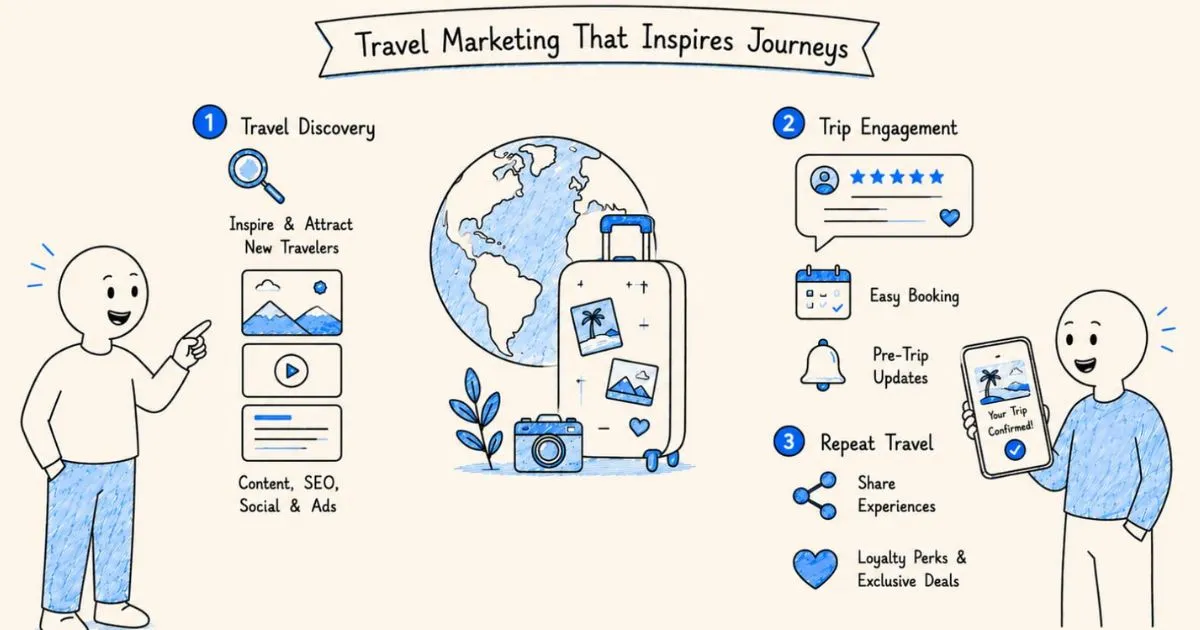
Travel marketing sells a feeling before it sells a destination. The traveller who books a tour, a holiday package, or a travel experience has already imagined themselves there — your marketing’s job is to get them to that imagining, make it vivid enough to be compelling, and then remove every obstacle between imagination and booking. Whether you’re a specialist tour operator, a destination management company, a travel agency, or an adventure travel brand, the fundamentals are consistent: inspire, build trust, and convert. These 22 ideas cover what actually works in travel marketing today.
1. Build Your Google Business Profile and Keep It Current
For travel businesses with a physical presence — a high street agency, a tour operator office, a visitor centre — a complete and maintained Google Business Profile is the starting point for local discovery. Optimise every field, upload regular photos from recent trips, collect Google reviews from clients who’ve returned from a trip, and post updates when new destinations or experiences are available. For online-only travel brands, ensure your brand appears correctly in Google’s Knowledge Panel by maintaining consistent NAP (Name, Address, Phone) information across the web and verifying your Google Business presence. Strong Google presence is the foundation of any travel brand’s digital marketing.
2. Invest in Video Content That Puts Viewers in the Destination
No medium sells travel like video. A well-produced destination reel — the sound of a market at dawn, the visual sweep of a coastal landscape, the warmth of a local encounter — communicates what no photograph or description can. Invest in destination video as your primary content format: one polished hero film per destination per year, supplemented with raw, authentic short-form content from ongoing trips. Post consistently to YouTube for long-term searchable discovery and to Instagram Reels and TikTok for short-form algorithm reach. The travel brands with the highest-performing social media accounts are those that make the viewer feel the destination before they’ve read a word.
3. Create Genuine Destination Guides That Rank in Search
Travellers researching destinations use search engines extensively in the inspiration and planning phases. “Best time to visit [destination],” “things to do in [place],” “is [destination] safe for solo travellers” — these are high-volume searches made by people who may eventually book a trip if the right option is presented. A content programme that publishes genuine, detailed destination guides — written by people who’ve actually been — generates sustained organic traffic from audiences in the early research phase and positions your brand as the trusted expert they return to when they’re ready to book.
4. Collect and Showcase Client Reviews and Trip Reports
Travel is a high-consideration, high-expenditure purchase. Prospective customers read reviews, comparison shop, and seek social proof extensively before committing. A systematic review collection process — emailing clients within a week of returning from a trip, asking for a review on Google or TripAdvisor, and requesting a trip report or quote — builds the social proof library that converts anxious prospective bookers into customers. Feature named testimonials with specific trip details prominently on every destination and product page. The specificity matters: “Jane booked our Nepal trekking trip and here’s what she said” is vastly more persuasive than a generic five-star rating.
5. Partner With Travel Influencers Who Actually Know the Destination
Travel influencer marketing works when the influencer is a genuine traveller whose audience trusts their recommendations — not when it’s a sponsored holiday with a paid post. Seek out influencers who have specific credibility in your destination or travel niche: adventure travel creators for adventure trips, solo female travel voices for solo itineraries, family travel bloggers for family holidays. The partnership should feel authentic because it is: the influencer chooses to go on the trip because it’s genuinely relevant to them and their audience. Negotiate for multiple content pieces across different formats rather than a single sponsored post, and ensure the content disclosure is clear and the creative freedom is genuine.
6. Build a Remarketing Strategy for High-Intent Website Visitors
A visitor who browsed your Tanzania safari page, spent three minutes reading the itinerary, and then left without enquiring is a warm lead with demonstrated interest. Remarketing campaigns — served on Google Display, Facebook, and Instagram — keep your brand and that specific destination visible to these visitors as they continue their research. Travel has a long consideration cycle; a prospective customer may research a trip for weeks before booking. A well-designed remarketing sequence that follows them through that research process with relevant destination content and a specific call to enquire recovers a significant proportion of visitors who would otherwise have booked with a competitor.
7. Run a Referral Programme for Returning Travellers
Clients who’ve had an exceptional trip experience are your most effective sales team — they talk about it to everyone they know. A formal referral programme that rewards them for introducing friends and family — a travel credit, a complimentary upgrade on their next booking, or a meaningful gift on the referred client’s departure — creates an explicit mechanism for the word-of-mouth that’s already happening informally. Reach out personally to your ten most enthusiastic recent clients with a specific referral offer. In travel, a referred booking from a trusted friend typically requires far less sales effort than a cold enquiry and generates a client who is pre-set for a positive experience.
8. Create an Email Newsletter With Genuine Destination Inspiration
A monthly email newsletter that takes subscribers to a destination through vivid writing, photography, and the personal voice of someone who’s been there generates the regular inspiration that keeps your brand front-of-mind during the months or years between trips. The newsletter that performs best in travel marketing is one that readers look forward to — that makes them feel something, that sparks a conversation with a partner or friend about going — rather than one that simply lists available departures. Grow your subscriber list at every touchpoint and treat the newsletter as a relationship-building asset, not a promotional broadcast. The payback comes at booking time, often many months later.
9. Be Active on Pinterest With Destination and Travel Inspiration Content
Pinterest is the planning platform for travellers — users create destination boards, save itinerary inspiration, and collect accommodation ideas months or years before they book. A consistent Pinterest presence that populates those boards with your destination content puts your brand into the traveller’s consideration set at the earliest possible stage of the planning process. Pin every piece of destination content with keyword-rich descriptions and direct links to your destination pages. Pinterest content has a long shelf life — a pin published today can generate traffic and bookings two years from now. Travel brands that invest in Pinterest consistently report it as one of their highest-quality organic traffic sources.
10. Develop Special Interest Products That Market to Passionate Communities
Specialist travel experiences — wildlife photography tours, culinary trips, yoga retreats, walking and hiking programmes, cultural immersions, wine holidays — are marketed to communities of passionate people who are already deeply engaged with the subject matter. These communities have their own publications, social media groups, events, and influencers. A wildlife photography tour can be marketed through photography forums, camera brand communities, and nature photography Instagram accounts. The specificity of the product is itself the marketing — it tells the right audience that this trip is made for them, which reduces price sensitivity and increases word-of-mouth within the community.
11. Use Social Proof From Past Trips Continuously in Advertising
Travel advertising that uses genuine client photography — with permission — consistently outperforms professionally produced travel imagery in digital advertising. Real people on real trips carry the credibility that stock photography or brand shoots cannot manufacture. Run paid social campaigns featuring genuine client photography and testimonial quotes from recent trips. The authenticity of real images from real trips resonates with prospective customers who are weighing whether to trust a company they haven’t experienced before. Combine genuine client imagery with a specific benefit claim — the number of countries visited, years of operation, or a specific outcome guarantee — and the combination consistently generates strong enquiry rates.
12. Build Strong Relationships With Corporate Travel Buyers
Corporate travel — incentive programmes, team experiences, executive retreats, conference pre- and post-tours — represents high-value group bookings with repeat potential. Corporate travel buyers are reachable through LinkedIn, industry events, and PA and EA networks. Build a dedicated corporate travel offer — with easy group booking, invoicing, and a specific contact who manages corporate accounts — and market it specifically to companies in sectors where incentive travel is common (financial services, pharmaceuticals, tech). A single corporate relationship that books an annual incentive programme can represent more revenue than dozens of individual leisure bookings, with significantly lower acquisition cost per booking.
13. Offer a Best Price Guarantee and Market It Explicitly
Price is a primary consideration in travel decisions, and a credible best price guarantee — backed by a clear, easy-to-redeem process — removes the price-shopping hesitation that prevents some prospective customers from booking. Publicise the guarantee on every booking page, in advertising, and in your email communications. Ensure the redemption process is genuinely easy — a simple form or email, with a quick response — so that the guarantee is credible rather than aspirational. Travel brands with a genuine and clearly communicated best price guarantee consistently convert a higher proportion of enquiries to bookings because they remove the “I should check elsewhere first” objection that most travel buyers feel.
14. Get Listed and Featured in Travel Awards and Publications
Award recognition — Responsible Tourism Awards, Conde Nast Traveller’s Specialist Travel Agent of the Year, Which? Recommended Provider, or specialist destination awards — provides third-party endorsement that carries significant weight with prospective customers making high-value booking decisions. Apply for awards in your category annually. Actively pitch to travel publications for editorial coverage — trend stories, destination features, expert commentary. Being named in a “best tour operators” roundup by a trusted travel publication generates a credibility signal that no amount of self-promotional advertising can match, and the backlink and traffic value of such coverage compounds for years.
15. Create Pre-Departure and Post-Trip Content That Extends the Relationship
The relationship with a booked client in the months before their trip is a marketing opportunity that most travel brands underuse. A series of pre-departure communications — destination preparation guides, packing lists, personal notes from the trip leader, cultural briefings — builds excitement and reduces pre-trip anxiety in ways that convert satisfied customers into enthusiastic advocates before they’ve even departed. Post-trip communications — photo-sharing requests, review prompts, “already thinking about next time?” messaging — maintain the relationship at the moment of peak satisfaction, when the client is most receptive to future bookings and most motivated to recommend to others.
16. Use Long-Form Content to Own Your Destination Niches in Search
The travel company that publishes the most genuinely useful content about a specific destination — a 3,000-word guide to trekking in Bhutan, a comprehensive itinerary for two weeks in Jordan, a season-by-season guide to the Galapagos — tends to rank first for the searches that motivated buyers make. Long-form destination content requires genuine knowledge, and that authentic expertise is exactly what Google’s search algorithm increasingly rewards and what prospective customers trust. A content library of twenty destination deep-dives drives more qualified organic traffic than a hundred short blog posts and positions your brand as the definitive resource for travellers researching those specific trips.
17. Attend and Speak at Travel Trade Events and Consumer Shows
Travel trade events — World Travel Market, ITB Berlin, specialist adventure travel shows — and consumer travel shows connect you with both industry partners and prospective customers in formats that digital marketing cannot replicate. Face-to-face conversation at a travel show from a genuine expert who can answer specific questions about a destination converts prospective customers at far higher rates than digital enquiries. Ensure your stand design, materials, and team are aligned on your brand’s key message and offer. Speaking opportunities — panel discussions, destination presentations — extend your visibility and credibility beyond your stand to the entire show audience.
18. Build an Affiliate and Trade Partner Network
Travel agents, complementary travel brands, and destination-specific content sites can act as a distributed sales force for your trips if you build a structured affiliate or trade partner network. Agents who sell your trips take a commission on bookings; content sites that review your trips take an affiliate fee on enquiries that convert. Build a formal partner programme with clear commission rates, marketing materials, training resources, and a dedicated partner contact. A well-managed partner network generates bookings at a predetermined cost per sale without the unpredictability of paid advertising, and it scales as the quality of your programme attracts more partners over time.
19. Use WhatsApp and SMS for Post-Enquiry Follow-Up
Travel enquiries are time-sensitive — a prospective customer who submits an enquiry and receives no response for twenty-four hours often books with a competitor who responds in minutes. WhatsApp and SMS follow-up, sent within minutes of an enquiry with a genuine personal message from a travel consultant, dramatically improves contact rates and conversion compared to email-only follow-up. These channels are also effective for the ongoing sales conversation once contact is established — prospective customers are more responsive to WhatsApp messages than emails during a booking discussion. Build a protocol for immediate WhatsApp or SMS outreach on every new enquiry and measure the impact on conversion rates within the first month.
20. Develop a Loyalty Programme for Repeat Travellers
Frequent travellers — those who take one or more trips per year through the same operator — represent the highest-value customer segment in travel. A loyalty programme that recognises and rewards their repeat business with meaningful benefits — priority booking access, exclusive destination offers, complimentary upgrades, a named senior contact — gives them a specific reason to continue booking through you rather than exploring alternatives. Identify your ten most frequent customers and contact them personally with a recognition of their loyalty and a tailored offer. The lifetime value difference between a one-time customer and a loyal traveller who books annually for a decade is extraordinary, and the acquisition cost of a retained customer is negligible.
21. Create Group Booking Products That Incentivise Social Sharing
Group travel — whether friends celebrating a milestone, families reuniting, colleagues rewarding performance, or communities with shared interests travelling together — represents a booking type where one converted customer generates multiple bookings. Design group booking products with the social sharing dynamic in mind: a group leader benefit, an easy sharing mechanism for the itinerary, and content that’s designed to be forwarded to potential fellow travellers. Marketing that’s designed to be shared within social groups — anniversary trip inspirations, reunion holiday ideas, friend group bucket list content — reaches warm audiences through trusted personal referral rather than cold advertising.
22. Measure Every Marketing Channel Against Actual Bookings, Not Enquiries
Travel marketing is full of channels that generate enquiries without generating bookings. A social media channel with high engagement that produces no enquiries. A content programme that drives traffic but to audiences who never book. A paid search campaign that generates enquiries that your sales team never converts. The only metric that matters in travel marketing is bookings and the revenue they represent, traced back to the channel and campaign that originated them. Build a tracking system — ask every customer how they found you, use UTM parameters on digital links, track enquiry source in your CRM — and review channel performance against bookings monthly. Allocate budget to what generates revenue, not what generates traffic.