Insurance is one of the most challenging categories to market. The product is intangible, the purchase decision is often reluctant, and most buyers actively avoid thinking about insurance until they need it. Yet the companies and brokers that do it well have built some of the most loyal customer bases in financial services — because when insurance actually delivers at the moment of claim, the trust it generates is profound. Marketing insurance well means being found when buyers are ready, being trusted enough to convert, and retaining customers beyond the first policy. These 37 ideas cover every stage of that challenge.
1. Claim Your Google Business Profile and Optimise It Fully
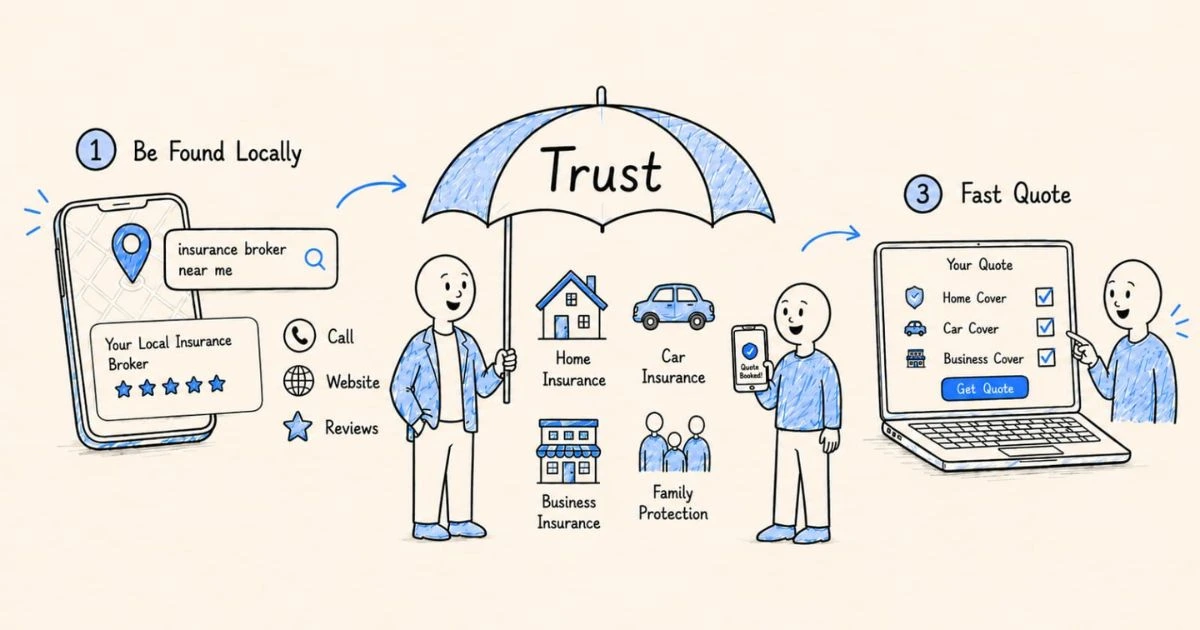
For insurance brokers with a physical presence, a complete Google Business Profile is the foundation of local discovery. Customers who search for “insurance broker near me” or “[type] insurance in [your area]” see your profile before they see your website. Fill in every field: address, phone, hours, insurance categories offered, and a description rich with the specific products and specialisms you offer. Request and respond to Google reviews regularly. An optimised profile generates significantly more direct calls and website visits than a neglected one and establishes local credibility before a prospective customer has visited your website.
2. Build Dedicated Landing Pages for Each Insurance Product Line
A single “our products” page on your website ranks for nothing specific and converts visitors poorly. Individual landing pages for each product — home insurance, motor insurance, professional indemnity, landlord insurance, travel insurance — each optimised for the exact search terms a prospective buyer uses, generate targeted organic traffic from people actively looking for that specific cover. Each page should include what’s covered, what’s excluded, who needs it, how the claims process works, and a clear call to action. Product-specific pages rank better, convert better, and serve the customer better than generic product overview pages.
3. Publish Plain-Language Guides to Complex Insurance Topics
The insurance category is full of confusing terminology, complex exclusions, and misunderstood coverage. A content programme built around genuinely helpful, plain-language explanations — “what does public liability insurance actually cover?”, “do I need professional indemnity insurance as a freelancer?”, “what’s the difference between third party and comprehensive car insurance?” — attracts organic search traffic from people in the research phase with high commercial intent. These searchers are prospective buyers who are confused and looking for guidance. Position your brand as the helpful expert who explains things clearly and they’ll convert to enquiry at significantly higher rates than those who arrive via a comparison site.
4. Get Your Products Listed on Price Comparison Sites Strategically
Comparison sites — GoCompare, Compare the Market, MoneySuperMarket, Confused.com — generate significant volume of insurance enquiries but at competitive prices and with high commission costs. Treat them as one channel in a balanced mix rather than the primary customer acquisition strategy. Monitor your competitiveness on comparison sites for your key product lines, optimise your listings for visibility, and ensure that the customer experience from comparison site to purchase is frictionless. Build a strategy for converting comparison site customers to direct relationship customers on renewal, reducing the dependency on comparison sites for repeat business over time.
5. Build a Referral Programme for Your Best Clients
Insurance clients who’ve had a claim handled well — or who’ve worked with a broker who genuinely found them better cover than they had before — are motivated advocates who need only a simple mechanism to refer. A referral programme with a meaningful incentive — a gift card, a premium discount, a donation to their chosen charity — creates that mechanism. Reach out personally to your twenty most satisfied clients and ask them directly. The referred clients that result from these conversations arrive pre-sold on your expertise, convert at significantly higher rates than cold enquiries, and are more likely to be the type of client whose needs align with your strengths.
6. Target High-Intent Keywords With Google Ads
Insurance buyers searching Google for specific cover are among the highest-intent audiences in any marketing context — they know they need insurance and they’re actively comparing options. Google Ads targeting terms like “cheap [type] insurance,” “[type] insurance quote,” and “[type] insurance for [specific audience]” captures these buyers at the moment of decision. Insurance is a competitive paid search category with high CPCs, so success requires precise targeting, compelling ad copy, and a landing page experience that converts. Focus your budget on the product lines and customer segments where you have a genuine competitive advantage rather than competing across all products.
7. Invest in Trust Signals Throughout Your Website and Marketing
Insurance buyers are making a financial decision based entirely on trust — they’re buying a promise that will be fulfilled in a future they hope never happens. Trust signals throughout your marketing — FCA registration details, accreditation logos, Trustpilot rating, named testimonials with specific claim experiences, media mentions, and years in business — address the primary psychological barrier to purchase. Display these signals prominently on your homepage, in your advertising, in email communications, and on every product page. The insurance brands and brokers with the strongest trust signals consistently convert a higher proportion of enquiries to policies.
8. Create Dedicated Marketing for Niche or Specialist Products
The most profitable insurance businesses are often those that serve a specific niche with deep expertise rather than competing across all lines. Specialist cover — professional indemnity for creative industries, landlord insurance for portfolio landlords, liability insurance for specific trades, classic car insurance, or insurance for a specific profession — allows you to position as an expert and charge accordingly. Niche insurance marketing works because the audience is specific and reachable: professional associations, trade publications, specialist online communities, and targeted digital advertising. Businesses that serve a niche well generate referrals within that community that compound over time.
9. Use Email Marketing for Policy Renewal Campaigns
The insurance renewal window is the highest-churn period in the customer relationship — and proactive, personalised email communication significantly reduces the number of clients who lapse or shop elsewhere. A renewal campaign that begins sixty days before renewal, includes a genuine review of coverage needs, and provides a personalised recommendation (not just a renewal quote) retains clients at significantly higher rates than a single renewal notice sent thirty days before expiry. Build a renewal email sequence for every client segment and personalise it by product line, client tenure, and claims history. The cost of retaining a client at renewal is a fraction of the cost of acquiring a new one.
10. Partner With Accountants, Solicitors, and Business Advisors for B2B Referrals
Accountants who advise small businesses regularly field questions about professional indemnity, public liability, and employer’s liability insurance — areas where most of their clients are underinsured or paying too much. A formal referral relationship with accountancy firms, legal practices, and business advisors generates a stream of well-qualified B2B enquiries from clients who arrive with a trusted professional’s endorsement. Build these relationships with a genuine service offer: a free insurance audit for their clients, a co-authored content piece on business insurance essentials, or a lunch-and-learn session for their team. Professional referral relationships in insurance are among the highest-ROI acquisition channels available.
11. Build Credibility Through Professional Association Memberships and Accreditations
Membership of BIBA (British Insurance Brokers’ Association), Chartered Insurance Institute accreditation, or Lloyd’s coverholder status communicate professional credibility in ways that marketing alone cannot. Display these affiliations prominently across your marketing. For specialist products, being an approved supplier to a relevant professional association — covering their members with preferred rates and specialist knowledge — generates a captive, well-qualified audience with built-in trust. Association endorsement is particularly powerful in B2B insurance, where decision-makers treat peer organisation recommendations as a significant signal of broker quality.
12. Use Video to Explain What Insurance Actually Covers
Short explainer videos — “what does employers’ liability insurance cover?”, “how does the claims process work?”, “why do you need professional indemnity as a consultant?” — address the confusion that prevents many buyers from acting. Video is more engaging and more shareable than text for educational content, and YouTube ranks these videos in Google search results, creating a second discovery channel for your content. A library of twenty well-produced explainer videos positions your brand as genuinely helpful and expert, addresses the common questions your sales team fields daily, and reduces the friction between interest and purchase for uninformed prospective buyers.
13. Develop a Content Series Around Industry-Specific Risk
A content series addressing the specific risks faced by a particular industry — construction, hospitality, professional services, creative agencies — demonstrates specialist knowledge that generic insurance marketing cannot. “The five liability risks most construction companies overlook,” or “why photographers need more than just standard business insurance” — these pieces speak directly to the concerns of a specific audience and rank for the exact searches those people make. Publish two to three industry-specific articles per month and promote them in the trade publications, LinkedIn groups, and online communities where that industry gathers. Industry-specific content generates higher-quality enquiries than generic insurance content.
14. Run a Free Insurance Audit Offer for Business Clients
A complimentary insurance audit — an honest review of a business’s existing cover against its actual risk profile — is a genuinely valuable service that creates a natural entry point for a commercial relationship. Most businesses are either over-paying, under-insured, or both. The audit demonstrates your expertise, creates immediate value before any transaction, and positions you as a trusted advisor rather than a salesperson. Market the audit offer specifically to business owners in your target sectors, via LinkedIn, local business networking, and accountancy referrals. A well-run audit programme converts at very high rates because the value is demonstrated before any financial commitment is requested.
15. Build a Strong Presence on LinkedIn for Commercial Lines
For brokers focused on commercial insurance, LinkedIn is the primary digital channel where business decision-makers — directors, operations managers, HR leads — spend professional time. A consistent LinkedIn presence combining educational insurance content, client case studies, industry risk commentary, and genuine engagement with target communities builds the professional reputation that generates inbound enquiries from businesses who find you when they have an insurance question. Publish two to three posts per week, engage with others’ content thoughtfully, and participate in relevant industry groups. LinkedIn organic reach for well-produced professional content consistently outperforms paid LinkedIn advertising in insurance at lower cost.
16. Monitor and Respond to Reviews on Google and Trustpilot
Insurance buyers read reviews carefully before committing to a provider or broker. A strong Trustpilot or Google review profile — with genuine testimonials from named customers describing their claim experience or the service they received — provides the social proof that addresses the primary purchase barrier. Build a systematic review generation process: ask every satisfied client for a review at the point of highest satisfaction, whether that’s after a smooth claims experience, a successful policy recommendation, or a renewal with a saving achieved. Respond to every review professionally. The brokers and insurers with the strongest review profiles consistently convert a higher proportion of website visitors to enquiries.
17. Create a Free Download Resource That Attracts B2B Leads
A genuinely useful free download — “the complete insurance checklist for small businesses,” “the landlord’s guide to rental property insurance,” “the contractor’s guide to professional indemnity” — attracts well-qualified leads who are actively researching their insurance needs. Gate the download behind an email capture form and follow up with a personalised email sequence that deepens the education and eventually offers a free review or quote. The quality of leads generated by relevant educational content is consistently higher than those from comparison site clicks or generic advertising because the downloader has already demonstrated specific interest in the topic your product addresses.
18. Use Segmented Email Campaigns for Different Client Types
A single email newsletter sent to your entire client database treats a sole trader the same as a managing director of a fifty-person business, and an existing client the same as a cold prospect. Segmented email campaigns — tailored by product line, business type, client tenure, and policy status — deliver relevant content and offers to each group and perform significantly better than unsegmented broadcasts. A landlord segment receives content about rental property legislation. A contractor segment receives IR35 updates and professional indemnity guidance. Relevant, segmented email marketing builds the sense that you understand your clients’ specific situations, which is the primary driver of insurance loyalty.
19. Publish an Annual Insurance Market Report for Your Key Sectors
An annual report summarising market conditions, rate trends, claims statistics, and emerging risks in your key sectors positions your firm as a genuine market authority. This content is of genuine value to business owners, risk managers, and financial advisors who need to understand the insurance environment they’re operating in. Distribute it via email to your client and prospect database, publish it on your website for organic search value, promote it on LinkedIn, and offer it to trade publications in your key sectors as editorial content. A well-researched market report generates press coverage, backlinks, and a continuous stream of enquiries from businesses who found it through search or referral.
20. Host Networking Breakfast Events for Target Business Audiences
A breakfast briefing for business owners in a specific sector — covering key risks, market changes, and insurance considerations — positions your firm as an educator rather than a salesperson, and creates the personal relationships that generate commercial insurance business. Invite twenty to thirty business owners from your target sector, partner with a relevant speaker (an accountant, a solicitor, or an industry expert), and keep the insurance content informative rather than promotional. Follow up every attendee personally within 48 hours. These events generate high-quality pipeline from warm contacts who’ve experienced your expertise in person — a significantly different quality of relationship than cold digital enquiries.
21. Develop an Online Quote Tool for Personal Lines Products
An instant online quote tool for personal lines products — motor, home, travel, pet — captures prospective buyers who want to understand cost before speaking to anyone. The tool also generates a significant volume of comparison data and lead information. Build the quote tool to be genuinely fast and simple, require minimal information at the initial stage, and follow up partial completions (where someone entered information but didn’t buy) with a personalised call or email within two hours. Quote tool abandonment recovery is one of the highest-ROI conversion optimisation activities available to personal lines insurers and brokers.
22. Partner With Trade Associations to Reach Their Members
Trade associations — the Federation of Master Builders, the Association of Accounting Technicians, the Society of IT Management — maintain direct relationships with the exact business professionals who need specialist insurance. A partnership arrangement that makes you the recommended or preferred insurance provider for an association’s members provides access to a defined, warm audience with built-in credibility. Association partnerships typically require a negotiated rate discount for members, a presence at association events, and content contributions to association publications — a structured investment that generates a reliable stream of well-qualified enquiries from a specific professional community.
23. Use Direct Mail for High-Value Commercial Prospects
In a world where email inboxes are saturated, a well-produced piece of direct mail — a personalised letter, a genuinely useful printed guide, or a memorable piece — stands out to the senior business decision-makers who are often the target for commercial insurance marketing. A targeted direct mail campaign to businesses of a specific size in a specific sector, with a compelling and specific reason to respond (a free audit, a market report, a relevant risk statistic), consistently outperforms email for opening and reading rates among busy executives. Combine direct mail with email and LinkedIn follow-up for a multi-touch outreach approach to high-value commercial prospects.
24. Invest in Claims Marketing — Tell Your Claims Stories
The moment of truth in insurance is the claims experience. Marketing that tells genuine claims stories — what happened, how the claim was handled, what the outcome was for the client — is the most persuasive content available to any insurance brand. With the client’s permission, document and share these stories: the business that survived a flood because their cover was right, the professional who avoided a six-figure lawsuit because their professional indemnity held. Claims stories address the primary purchase scepticism in insurance — “will it actually pay out?” — with specific, named evidence that advertising claims cannot match.
25. Create a Dedicated Microsite or Section for Contractor Insurance
Contractors — IT consultants, engineering contractors, freelance professionals — are one of the most active self-research segments in insurance. They need a combination of professional indemnity, public liability, and often IR35-related cover, and they actively search for this information online. A dedicated section of your website — or a standalone microsite — built specifically for contractors, with content that addresses their specific risks, a tailored quote journey, and community-relevant content about IR35 and relevant legislation, generates organic search traffic and enquiries from this high-value segment at significantly better rates than a generic product page.
26. Use Remarketing to Re-Engage Visitors Who Read But Didn’t Enquire
A visitor who read your professional indemnity guide and then left without contacting you has demonstrated strong interest. Remarketing campaigns on Google and social platforms keep your brand visible to these visitors as they continue their research, creating multiple opportunities for them to return and enquire. Tailor remarketing creative to the specific content the visitor engaged with — a visitor who read about landlord insurance sees landlord-specific remarketing, not generic brand ads. Segmented, content-relevant remarketing converts at significantly higher rates than generic brand remarketing and costs a fraction of acquiring new visitors to the same pages.
27. Build a Chatbot for Out-of-Hours Enquiry Capture
Insurance enquiries don’t observe business hours. A chatbot on your website that captures enquiries, answers frequently asked questions, and qualifies prospects outside of office hours ensures that potential clients who visit your website in the evening don’t simply leave without engaging. The chatbot doesn’t need to replace human conversation — it needs to capture contact details, identify the insurance type needed, and set the expectation of a call-back during business hours. Leads captured via chatbot who receive a follow-up within the next business morning convert at significantly higher rates than web enquiries that wait twenty-four or more hours for a response.
28. Develop a Commercial Insurance Blog Targeting CFOs and Risk Managers
The decision-maker for commercial insurance in a mid-sized business is often a finance director, CFO, or dedicated risk manager. A blog that addresses their specific concerns — total cost of risk, regulatory compliance, director and officer liability, cyber risk quantification, supply chain insurance — speaks to them at a professional level that generates trust and positions you as a peer-level expert rather than a vendor. Publish content informed by your claims experience and market knowledge. Share it via LinkedIn and via direct email to your commercial prospect database. Thought leadership content targeted at senior financial decision-makers generates better commercial enquiries than broad-audience educational content.
29. Sponsor Local Business Awards and Community Initiatives
Sponsoring a local business awards event — the Chamber of Commerce awards, a regional business growth event, a trade association annual dinner — puts your brand in front of exactly the business decision-makers who need commercial insurance, with the implied endorsement of the organising body. Sponsorship delivers brand presence, a named table at the event for relationship building, and typically some editorial presence in the event materials and publicity. Choose sponsorships where the audience aligns with your target client profile and where you can be genuinely present at the event rather than just providing a logo. The relationships built at well-chosen business events compound over years into significant commercial relationships.
30. Create a Cyber Insurance Marketing Programme for SMEs
Cyber insurance is the fastest-growing commercial insurance line and also the most misunderstood. A dedicated marketing programme targeting SMEs on cyber risk — content explaining what cyber insurance covers, how a ransomware claim actually works, what the regulatory obligations are after a data breach — positions you at the front of a rapidly expanding market. Most SME decision-makers don’t yet have cyber cover and don’t yet understand why they need it. Educational marketing that explains the risk in plain terms, supported by real-world case studies (with appropriate anonymisation), generates enquiries from prospects who arrive pre-convinced that they need the product and just need help choosing the right policy.
31. Build a Partner Programme With Mortgage Brokers for Home Insurance Cross-Sells
A mortgage completion requires buildings insurance. Mortgage brokers who refer their clients to you for buildings and contents insurance generate a stream of highly motivated, time-sensitive leads who need cover immediately. Build a formal referral programme with mortgage brokers in your area: a simple referral process, a competitive product, prompt service for their clients, and a meaningful referral fee or reciprocal referral arrangement. The mortgage completion is one of the highest-quality trigger events in insurance — the buyer is obligated to have cover, has the property value and address already established, and needs a quick, painless purchase experience.
32. Market Your After-Hours Claims Support as a Differentiator
The biggest frustration insurance customers report is being unable to get help when something goes wrong — which, by definition, often happens outside business hours. A 24-hour claims helpline, an emergency claims WhatsApp contact, or a committed “we’ll call you back within one hour” guarantee is a genuine competitive differentiator that should be prominently marketed. Claims support availability addresses the core purchase anxiety of insurance buyers: “will they actually be there when I need them?” Feature it explicitly in your advertising, on your website, and in your renewal communications. Clients who know from experience that you’re available in an emergency don’t shop around at renewal.
33. Use Case Studies From Claims to Demonstrate Policy Value
A business owner who doesn’t understand why they need employer’s liability insurance is far less resistant once they read a specific case study: a similar business, an employee injury, a claim for £85,000 that was covered in full. Case studies built around realistic scenarios your clients face are the most persuasive form of insurance marketing available because they make the abstract concrete. Develop a library of ten to fifteen case studies across your main product lines, with the client’s permission or anonymised where necessary. Use them on product pages, in email campaigns, in face-to-face client meetings, and in advertising. Specific evidence converts sceptics better than any general benefit claim.
34. Invest in a Content Partnership With a Relevant Industry Publication
A content partnership — a regular column in a trade publication, a sponsored guide in an industry magazine, or a bylined article series — reaches your target business audience with the credibility of editorial context rather than the scepticism that advertising generates. Identify the publications where your target clients spend reading time and propose a genuine content contribution: insurance guidance for their industry, risk commentary, or legislative updates that affect their sector. Publications welcome expert contributors who can provide genuinely useful content; the result is sustained exposure to a highly relevant audience that grows in trust with each piece published.
35. Run an Annual Client Survey and Publish the Results
An annual client satisfaction survey — publicly shared, with honest reporting of the results including areas for improvement — demonstrates a commitment to transparency and accountability that very few insurance brands exhibit. Clients who are asked for their opinion and see evidence that it was heard are significantly more loyal than those who are never consulted. Publish the results on your website and share them on LinkedIn with commentary on what changes you’ve made in response. The willingness to be publicly accountable for client satisfaction signals confidence and professionalism that prospective clients respond to — particularly those who’ve been disappointed by insurance providers in the past.
36. Develop a Structured Onboarding Process for New Commercial Clients
The first ninety days of a commercial insurance relationship are the most critical for long-term retention. A structured onboarding — a formal policy review call, an introduction to the claims team, a risk management resource relevant to their sector, and a scheduled annual review date set from day one — creates the sense of a managed relationship rather than a transactional sale. Clients who experience a professional, attentive onboarding process are significantly less likely to shop the market at renewal. Build this process into your client management system and make it consistent for every new commercial account. Onboarding quality is a retention strategy as much as it is a service standard.
37. Measure Customer Acquisition Cost and Lifetime Value by Product Line
The most important analytical discipline in insurance marketing is understanding which products, client types, and acquisition channels generate the best lifetime value relative to acquisition cost. A personal lines motor client acquired cheaply through a comparison site and who churns at first renewal has very different economics from a commercial client referred by an accountant who renews for seven consecutive years and increases their cover annually. Build a reporting framework that shows customer acquisition cost, retention rate, and lifetime premium value by product line and acquisition channel. Marketing investment decisions grounded in this data consistently outperform those based on enquiry volume alone.