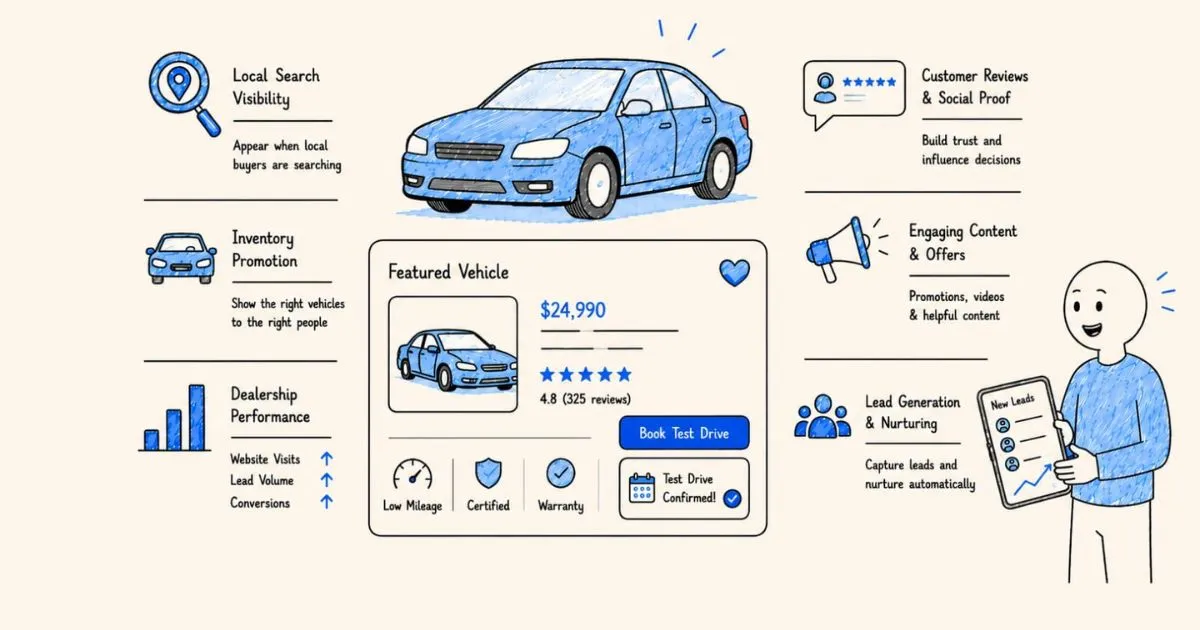
Automotive marketing sits at the intersection of high-emotion purchase decisions and intensely practical research behaviour. Buyers spend weeks or months researching online before they ever step onto a forecourt — and the dealers and brands that are present and compelling throughout that research journey win the lion’s share of sales. Whether you’re an independent used car dealer, a franchised new car retailer, a specialist vehicle brand, or an aftermarket service provider, the challenge is the same: be findable, be trustworthy, and make the experience of buying from you better than the alternative. These 28 ideas address all three.
1. Optimise Your Google Business Profile for Local Dealer Searches
Local searches for “car dealerships near me,” “[brand] dealer in [area],” and “used cars in [town]” are high-intent queries from buyers who are ready to visit a forecourt. A fully optimised Google Business Profile — complete with your stock overview, opening hours, phone number, photos of your forecourt and team, and a consistent stream of Google reviews — ensures you appear prominently and compellingly in these searches. Enable messaging and booking for test drives. Post regular updates when notable vehicles arrive. An optimised profile generates substantially more calls and showroom visits from local searches than a neglected one at zero ongoing cost.
2. Build a Video Walk-Around Strategy for Every Vehicle on Your Forecourt
A two-minute walk-around video for every vehicle on your stock — showing exterior, interior, specification highlights, and any notable features — provides online buyers with the information they need to shortlist vehicles before visiting. Post walk-arounds to YouTube with SEO-optimised titles and descriptions, and embed them on the relevant vehicle listing pages on your website. Dealers who produce walk-around video for their entire stock consistently report higher enquiry quality — buyers who arrive having watched the video are more committed and waste less showroom time — and higher conversion rates from enquiry to sale.
3. Invest in a Strong Vehicle Listing Platform Presence
AutoTrader, Motors.co.uk, CarGurus, and similar platforms are where the majority of UK vehicle searches begin. Maintaining high-quality listings on these platforms — with professional photography, accurate specification data, competitive pricing, and a complete description — is table stakes. Where most dealers compete on price, the opportunity is to differentiate on listing quality: more photos, better descriptions, a walk-around video link, and a transparent pricing statement. Platform algorithms also rank listings by quality signals — completeness of information, photo count, and engagement — so a higher-quality listing receives more views from the same level of investment.
4. Create a Finance Calculator Tool on Your Website
The majority of vehicle purchases in the UK are financed. An interactive finance calculator on every vehicle listing page — allowing buyers to adjust deposit, term, and mileage to see a monthly payment — keeps buyers engaged on your website rather than sending them to a comparison site. It also qualifies buyers early in their research by helping them understand affordability, which improves the quality of enquiries that reach your sales team. Ensure the calculator is compliant with FCA financial promotion requirements and links clearly to your finance documentation. Dealers with an effective on-site finance tool consistently report higher enquiry conversion rates than those without one.
5. Build a Content Programme Around Buyer Decision Points
Automotive buyers research extensively: which model to choose, petrol versus electric, PCP versus HP, what mileage is safe for a used car, what a full-service history means for value. A content programme that provides genuinely useful answers to these questions — in blog posts, videos, and comparison guides — attracts buyers at the research stage, before they’ve chosen a dealer, and positions your brand as the knowledgeable, trustworthy source they’ll return to when they’re ready to buy. Each piece of well-optimised content is a permanent traffic source. A library of twenty decision-oriented automotive guides can generate more sustained inbound enquiries than most dealers’ entire paid advertising budgets.
6. Run Targeted Social Media Advertising in Your Local Catchment Area
Facebook and Instagram advertising with radius targeting — reaching adults within a specific distance of your dealership who match the demographic profile of your typical buyer — is one of the most cost-effective awareness channels for local automotive businesses. A well-produced image or video ad featuring a specific vehicle or offer, served to people within five to fifteen miles of your showroom, generates measurable showroom traffic and enquiries. Run campaigns around specific stock arrivals, seasonal offers, and plate change periods. Measure campaign performance against actual enquiries and showroom visits, not just ad metrics. Social advertising works in automotive when the creative is strong and the targeting is precise.
7. Respond to Every Review and Reputation-Manage Proactively
Automotive is a category where online reviews have exceptional influence over purchase decisions. A prospect who’s deciding between two dealers will read reviews for both. A dealership with 150 reviews at 4.3 stars and consistent, professional responses to every review conveys a very different character than one with 30 reviews and no responses. Build a systematic review generation process: ask every satisfied customer directly at handover, follow up with an email the day after delivery, and make the review link immediately accessible. Respond to every review — positive and negative — within 24 hours. Reputation management in automotive is ongoing and high-priority, not periodic and optional.
8. Invest in Professional Vehicle Photography
The photography quality of your vehicle listings directly determines enquiry volume. A vehicle photographed professionally — on a clean background, at optimal angles, with good lighting that shows the paintwork clearly — generates significantly more enquiries than the same vehicle photographed in inconsistent lighting on a cluttered forecourt. Invest in a consistent photography setup: a clean background (preferably a dedicated photo area), a fixed set of angles for every vehicle, and a professional process. Dealers who upgrade to professional photography consistently see an immediate improvement in listing engagement rates. Photography quality is the most direct lever available for improving stock sell-through speed.
9. Build a Part-Exchange Marketing Programme
Part-exchange is a key decision point in the vehicle purchase journey — buyers want to know what their current car is worth before they commit to a new one. A part-exchange valuation tool on your website — instant, no-obligation, and easy to use — captures prospective buyers at this critical moment and begins a relationship before they’ve visited the forecourt. Market your part-exchange programme explicitly in advertising and on your website: “instant online valuation,” “guaranteed against AutoTrader value,” or “best part-ex prices in [your area].” Buyers who receive a transparent, fair part-exchange valuation are significantly more likely to purchase from the dealer who provided it than from one who was vague about part-ex value.
10. Use Email Marketing for Customer Retention and Service Upsells
The customers in your database — those who’ve bought from you in the last two to five years — represent a managed remarketing opportunity that most dealers significantly underuse. A structured email programme: service reminders triggered by vehicle age and mileage, annual MOT reminders, finance end-of-term notifications, and new model arrival alerts for owners of the outgoing version. These triggered communications are highly relevant, timely, and generate response rates that generic email marketing cannot approach. Retaining a customer for their next vehicle purchase is significantly cheaper than acquiring a new one, and email is the primary mechanism for making that retention systematic.
11. Develop a Strong Aftersales Marketing Programme
Aftersales — servicing, parts, accessories, and MOT — represents a high-margin revenue stream that sustains dealership profitability through slow retail periods. Marketing aftersales proactively: promoting your service capabilities to customers who bought from you, competing for servicing business on price and convenience against fast-fit centres, and offering service plans that lock in future revenue at the point of vehicle purchase. Service customers who are retained through the ownership cycle are more likely to buy their next vehicle from you. Aftersales marketing is simultaneously a profit centre and a retention mechanism, and most dealers invest less in it than its importance justifies.
12. Create a YouTube Channel Featuring Test Drive Reviews
YouTube automotive content attracts enormous viewership from buyers researching specific models. A channel featuring genuine test drive reviews of vehicles on your stock — shot authentically from a buyer’s perspective rather than a manufacturer’s promotional angle — generates organic search traffic from buyers who are specifically interested in those models. Rank the videos well with SEO-optimised titles, descriptions, and tags. Buyers who watch your test drive before visiting are significantly more qualified than cold showroom visitors. YouTube automotive content also builds your dealership’s personal brand in the local market and generates backlinks and referral traffic from automotive forums and communities where the reviews are shared.
13. Participate in AutoTrader’s Promotions and Boost Tools
Platform-specific advertising tools — AutoTrader’s Promoted listings, price indicators, and data products — can significantly increase the visibility and conversion of your stock within the platform. A vehicle highlighted as “price indicator: great price” converts at higher rates than an equivalent vehicle without the badge, because the platform’s credibility endorses your pricing. Use the platform’s own data on search trends and pricing benchmarks to inform your stock pricing strategy. Dealers who invest in understanding and using the platform’s tools strategically consistently outperform those who treat their listing as a passive listing rather than an active marketing asset within the platform’s search ecosystem.
14. Build a Relationship With Local Businesses for Fleet Sales
Fleet sales — vehicles supplied to businesses for employees, company use, or lease programmes — represent high-volume, lower-acquisition-cost sales compared to retail. Local businesses within your catchment area who operate company vehicles are accessible through LinkedIn, local business events, and direct outreach. Develop a fleet offer with competitive pricing, flexible terms, and a dedicated fleet contact who provides a higher service level than the standard retail process. The local business that switches its fleet maintenance and procurement to your dealership represents multi-vehicle purchasing over many years — a customer lifetime value that justifies significant investment in the initial relationship-building.
15. Use Google Ads to Capture High-Intent Vehicle Searches
Buyers who search Google for “[specific model] for sale in [your area],” “[brand] dealer near me,” or “used [model] [year] [budget]” are at the point of active purchase consideration. Google Ads targeting these specific, high-intent search terms captures buyers who are ready to enquire now. Unlike awareness advertising, which reaches people who aren’t actively searching, Google Ads captures people in the decision moment. Focus spend on the models you have strong stock of, the geographic area you serve, and the buyer intent signals most correlated with enquiry. Measure against actual enquiries and sales, not click volume.
16. Develop a Certified Pre-Owned Programme With Its Own Branding
A branded certified pre-owned programme — with a defined inspection checklist, a specific warranty, and clear consumer-facing guarantees — allows you to differentiate used stock from competitors and justify a price premium on your best vehicles. Market the CPO programme specifically: what’s checked, what’s guaranteed, what support the buyer has if something goes wrong. The buyer who pays a small premium for a certified vehicle over an equivalent without certification is a buyer who values assurance over price — and that buyer is typically less price-sensitive, more likely to refer, and more likely to buy their next vehicle from you. CPO programmes also generate press coverage from local automotive journalists who cover the consumer angle.
17. Host a Reveal Event for New Model Arrivals
The arrival of a new model — especially an electric vehicle or a significant facelift — is an event worth marketing. A reveal evening for interested customers and prospects: a viewing of the new vehicle, a product presentation by the brand representative, test drive slots, and an exclusive first-night offer for attendees. Events generate press coverage from local publications, social media content from attendees, and a sense of excitement around a product that’s otherwise just another stock arrival. Market the event to your database, to local automotive enthusiasts, and to the press. Customers who attend a reveal event are far more likely to place an order than those who discover the new model through a standard listing.
18. Build a Social Media Community Around Local Automotive Enthusiasm
A Facebook Group or Instagram account for local car enthusiasts — not a sales channel, but a genuine community platform for sharing automotive content, local car meets, maintenance tips, and driving routes — builds a warm, engaged audience of exactly the people most likely to buy from you. Dealerships that participate in local car meets and events with their social media presence build the community goodwill that makes them the natural first choice when community members are ready to buy. Automotive enthusiasm is a genuine community interest; being a facilitator of that community rather than just a vendor within it generates a level of brand loyalty that conventional advertising cannot buy.
19. Use Targeted Direct Mail for High-End and Classic Vehicle Buyers
For premium and specialist vehicle sales, targeted direct mail to prospective buyers in relevant postcodes — those with high household income indicators, those who own specific vehicle types that suggest an appetite for upgrade, or those identified through data partnerships as active car buyers — generates a response quality that digital advertising to cold audiences cannot match. A well-produced direct mail piece for a premium used vehicle — professional photography, a personalised letter, and a specific invitation to view — reaches buyers who respond to tangible, considered communication and who are often less reachable through standard digital channels.
20. Develop a Customer Handover Experience That Generates Referrals
The vehicle handover is the peak emotional moment in the customer’s purchase journey and the optimal moment to generate referrals. A handover experience that’s deliberate, celebratory, and genuinely attentive — a personal presentation from the salesperson who knows the customer’s name and their purchase story, a handover gift relevant to the vehicle, and a specific, personal ask for referrals — converts satisfied customers into active advocates at the moment of highest satisfaction. Train every salesperson to conduct the handover as a marketing event as well as a transaction completion. The referrals generated from a memorable handover experience have a higher closing rate than almost any other lead source.
21. Create Seasonal Campaigns Around Key Purchase Moments
Plate change periods (March and September in the UK), pre-summer campaigns for convertibles and leisure vehicles, winter campaigns for four-wheel drives and SUVs, and new year campaigns for buyers whose finance agreements ended over Christmas — these seasonal moments create natural marketing hooks. Build a calendar of seasonal campaigns planned twelve months in advance, with specific stock focus, tailored creative, and a consistent multi-channel execution: email to database, paid social, paid search, platform promotions, and direct mail. Seasonal campaigns allow you to focus your marketing investment during the periods when buyer intent is highest and your specific stock has the most appeal.
22. Partner With Local Sports Clubs and Community Organisations
A car dealership that sponsors a local rugby club, provides courtesy vehicles for a community event, or partners with a local charity demonstrates community investment that builds the goodwill that influences purchase decisions in a local market. The signage at a local sporting event, the vehicles at a community function, and the name in a local club’s newsletter all reach exactly the local buyers who are your primary market. Choose sponsorships that genuinely align with your brand values and target audience rather than seeking maximum exposure. Community presence that feels genuine generates more loyalty than logo placement on a ground nobody associates with your brand.
23. Train Your Sales Team in Digital Enquiry Response
The quality and speed of response to digital enquiries — website leads, AutoTrader messages, email enquiries — is one of the most significant variables in conversion rate for automotive dealers. An enquiry not responded to within an hour is frequently lost to a competitor who responded faster. A response that’s generic, template-driven, or doesn’t address the specific vehicle enquired about converts poorly regardless of speed. Train your sales team to respond to every digital enquiry within thirty minutes during business hours, personalise every response to the specific vehicle and buyer query, and follow up unanswered messages with a call the same day. Enquiry response quality is a more important conversion variable than stock quality for many dealers.
24. Invest in an EV-Specific Marketing Programme
Electric vehicle adoption is accelerating but buyer anxiety remains high: range, charging infrastructure, running costs, battery longevity, and the purchase experience itself are all areas of genuine uncertainty for many prospective EV buyers. A dealership or brand that addresses these anxieties specifically — with content, training, demonstration events, and a transparent communication about real-world EV ownership — is positioned far better in the EV segment than one that treats EV as just another product line. Host EV experience days, publish genuine range test content, offer home charging installation referrals. The buyers who switch to EV tend to be highly engaged advocates who actively refer within their networks, making EV customer acquisition particularly valuable.
25. Build a Presence on Automotive Forums and Enthusiast Communities
Automotive forums — model-specific communities on platforms like Pistonheads, specialist brand forums, and Reddit automotive communities — are where enthusiast buyers research in depth. Genuine participation in these communities — answering technical questions, sharing knowledge, being a visible and helpful presence without overt commercial intent — builds brand awareness and trust among the most knowledgeable and passionate buyers in the market. When a forum member is ready to buy, the dealer or brand that has been genuinely helpful in the community is the natural first consideration. This is a long-term strategy that rewards consistency rather than campaign-style activity.
26. Develop a Post-Sale Follow-Up Programme That Drives Advocacy
The customer experience after the sale determines whether a buyer becomes a repeat customer and an active referrer. A structured post-sale follow-up programme — a call at day three to check satisfaction, a note at one month, a service reminder at six months, and a personalised anniversary message at one year — keeps the relationship alive through the ownership period and ensures that when the buyer is ready for their next vehicle, you’re already in the conversation. Customers who receive thoughtful, non-promotional post-sale communication are significantly more likely to return and to recommend you to their network than those who receive nothing after the handover.
27. Use Video Testimonials From Genuine Customers in Advertising
A thirty-second video of a genuine customer at or shortly after handover — sharing their experience in their own words — is one of the most persuasive creative formats available for automotive advertising. The authenticity of real customers describing a real purchase experience addresses the trust concerns that most automotive buyers feel. Collect video testimonials systematically: a quick phone recording on handover day is sufficient. Use them in social media advertising, on your website, in email campaigns, and at the top of your Google Business Profile video gallery. Video testimonial advertising consistently outperforms professional produced brand creative in automotive for enquiry generation and conversion.
28. Measure Marketing ROI at Stock, Campaign, and Channel Level
Automotive marketing measurement needs to operate at multiple levels simultaneously: which campaigns drove the most enquiries, which channels converted enquiries to sales at the best cost per sale, and — most usefully — which marketing activities are associated with faster stock turn for specific vehicle types. A used car dealer who tracks the relationship between marketing investment and days-to-sale for different vehicle categories can make genuinely sophisticated decisions about where to concentrate spend. Build a reporting system that connects marketing activities to sales outcomes, not just enquiry volumes, and review it weekly during high-volume periods. The discipline of marketing measurement in automotive separates the dealers with improving profitability from those with unpredictable results.