Healthcare marketing operates at the intersection of scientific rigour, regulatory constraint, and profound human vulnerability. The patient or consumer researching a health condition, treatment option, or provider is not making a discretionary purchase — they’re navigating one of the most consequential decisions of their life, often while managing fear, uncertainty, and information overload. The marketing organisations that serve this audience well build genuine trust through evidence, empathy, and accessibility. Those that exploit the vulnerability of the health-seeking consumer generate short-term results and long-term reputational damage. In 2026, the healthcare marketing landscape is being reshaped by digital health adoption, AI diagnostics, direct-to-consumer pharmaceutical expansion, and a patient population that has never been more engaged with their own health. Here are the 13 trends defining healthcare marketing in 2026.
1. Patient-Centric Digital Marketing and Empowered Consumer Health
The health consumer of 2026 arrives at the point of care better informed, more digitally engaged, and more demanding of personalised communication than any previous generation. According to the Pew Research Center, 77% of online health information seekers begin their research on a search engine rather than a healthcare provider website. They’ve watched YouTube explainer videos about their symptoms, read Reddit discussions from people with similar conditions, and checked their provider’s Google reviews before booking an appointment. The healthcare organisations winning in this environment are those whose digital presence — website content, search visibility, review management, patient communication tools — genuinely serves the informed health consumer rather than simply broadcasting institutional messaging.
Patient-centricity in healthcare marketing means designing digital experiences around the patient’s information journey rather than the organisation’s service hierarchy. It means writing health content at the reading level and emotional register appropriate for someone who is worried about their health — accessible, honest, and calibrated to the real questions patients ask rather than the clinical terminology providers use. It means making it easy to book appointments, refill prescriptions, and communicate with care teams through digital channels that match the platforms patients already use. The health systems that have invested in genuinely patient-centred digital experiences — faster navigation, clearer information architecture, easy digital scheduling — are achieving measurably higher patient acquisition and retention rates than those whose digital presence remains an online brochure for their physical services.
2. Content Marketing for Health Literacy and Trust Building
Healthcare organisations that invest in high-quality, clinician-reviewed health education content are building the most durable marketing assets in the sector. The Mayo Clinic’s content library, Cleveland Clinic’s Health Essentials blog, and dozens of health system equivalents generate millions of organic search visitors monthly by answering the health questions that patients are actively asking — and in doing so, establishing the organisation as the authoritative, trustworthy source that patients remember and return to when they need care. According to the Content Marketing Institute, healthcare organisations that publish consistent educational content generate three times more leads than those relying on paid advertising alone, at significantly lower cost per acquisition.
The quality bar for healthcare content has risen significantly in 2026 due to Google’s specific E-E-A-T (Experience, Expertise, Authoritativeness, Trustworthiness) requirements for health and wellness content — what the algorithm designates as “Your Money or Your Life” pages where misinformation causes real harm. Content in these categories must demonstrate genuine clinical expertise, cite current research, and be reviewed by credentialled healthcare professionals to rank competitively. AI-generated health content that lacks clinical review is being algorithmically penalised and, more importantly, is failing the patients who rely on it. The healthcare organisations building content programmes grounded in genuine clinical expertise — with physician co-authors, current research citations, and regular clinical review cycles — are both ranking better and serving patients better, which is precisely the aligned incentive that makes content marketing a sustainable strategy in healthcare.
3. Telehealth Marketing and Digital Care Adoption
Telehealth adoption, which was forced into mainstream acceptance during the COVID-19 pandemic, has stabilised at usage rates significantly higher than pre-pandemic levels — and in some care categories, virtual-first is now the default rather than the alternative. McKinsey estimates that $250 billion of current US healthcare spending could be virtualisable, representing a massive market transformation still in early stages. The healthcare organisations and digital health companies that win the next decade will be those whose marketing effectively communicates the benefits of digital care access to patient populations that still default to in-person as a quality signal.
Telehealth marketing faces a specific adoption barrier: the perception that virtual care is inferior to in-person care for anything beyond the most basic consultations. Overcoming this requires evidence-based communication — specific conditions and specialties where telehealth outcomes are equivalent or superior, patient testimonials from care categories where virtual access reduced barriers significantly, and clear communication about when in-person care is genuinely more appropriate. The marketing channels most effective for telehealth adoption are those that reach patients in digital contexts where they’re already managing health: patient portal communications, health app integrations, and search engine marketing targeting the specific condition searches that lead to high telehealth conversion. Health systems that have built telehealth marketing as a distinct programme — with appropriate positioning, channel selection, and audience segmentation — are growing their virtual care volumes faster than those treating telehealth as a checkbox on their service list.
4. Direct-to-Consumer Pharmaceutical Marketing Evolution
DTC pharmaceutical marketing is undergoing significant evolution driven by regulatory updates, platform policy changes, and shifting consumer expectations around medication information and access. The FDA’s updating of guidance on digital DTC marketing — covering search ads, social media promotion, and influencer partnerships for prescription medications — has required pharmaceutical marketers to adapt existing programmes while navigating ambiguity in new channels. At the same time, the direct prescribing model — where patients can access certain medications through telehealth platforms with minimal friction — is blurring the boundary between pharmaceutical marketing and healthcare delivery.
The pharmaceutical brands navigating this landscape effectively in 2026 are those that treat digital DTC marketing as a discipline requiring both creative sophistication and regulatory expertise in equal measure. The most effective DTC digital campaigns combine condition education (which requires no product-specific claims), patient community engagement (building relationships with the populations the medication serves), and clear, regulation-compliant product information for patients who are already in the consideration phase. Working with medical, legal, and regulatory review teams early in the creative process — rather than as a final checkpoint — has become the operational model for pharmaceutical marketing teams that need to move at digital speed without regulatory exposure. Brands that have built this regulatory-creative integration into their process are producing more compliant campaigns faster than competitors still treating regulatory review as a sequential bottleneck.
5. Healthcare Social Media and Professional Community Marketing
Social media in healthcare operates under specific constraints — patient privacy requirements, professional credentialling expectations, and the potential for health misinformation to cause genuine harm — but within those constraints, it has become an essential marketing channel for reaching both patients and the healthcare professionals who influence care decisions. The healthcare organisations building effective social media presences in 2026 are navigating these constraints with specific content strategies: patient success stories with appropriate consent documentation, health education content produced and reviewed by clinical staff, community health campaigns that address relevant public health priorities, and behind-the-scenes content that humanises care teams in ways that build trust and connection.
The professional healthcare audience — physicians, pharmacists, nursing staff, and allied health practitioners — is increasingly reachable through social channels for pharmaceutical and medical device companies. LinkedIn’s professional targeting capabilities, Doceree’s healthcare professional advertising network, and medical professional communities on specialised platforms all enable manufacturer-to-HCP communication that complements traditional medical affairs and sales representative channels. Healthcare professional influencers — physicians with large social media audiences who communicate about clinical practice, health policy, and patient care — have become a significant channel for medical education and product awareness, with their reach extending into both professional peer networks and patient communities simultaneously. The regulatory requirements for HCP-targeted promotion differ by market and product category, but the channel’s commercial potential is established.
6. AI-Powered Patient Engagement and Personalised Health Communication
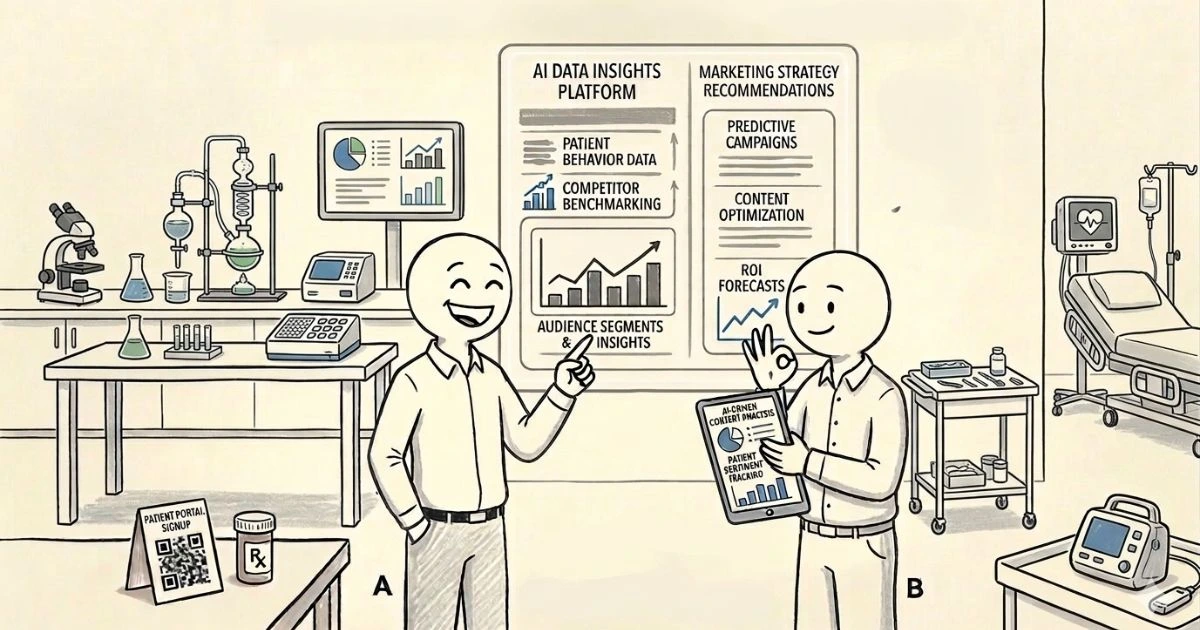
Artificial intelligence is enabling healthcare organisations to deliver patient communication at a personalisation level that was previously impossible at scale. AI-powered patient engagement platforms can send appointment reminders timed to individual response patterns, surface relevant health education content based on a patient’s documented conditions and care history, identify patients at risk of care gaps or medication non-adherence before they disengage, and personalise post-discharge follow-up communication to the specific care received. Nuance Communications research found that AI-powered patient engagement programmes reduce appointment no-show rates by 28% and improve medication adherence rates by 18% compared to generic reminder systems.
The marketing dimension of patient engagement AI extends into acquisition as well as retention. Health systems using predictive analytics to identify community members likely to require specific care services — based on demographic data, prior utilisation patterns, and population health signals — can deploy targeted outreach campaigns that connect at-risk individuals with relevant preventive services before a health crisis triggers an emergency department visit. This proactive care navigation marketing converts community health improvement objectives into business outcomes: an individual who receives a targeted mammography reminder that leads to early cancer detection becomes a patient whose lifetime relationship with the health system begins with a positive, trust-building interaction. The organisations embedding AI into their patient engagement and acquisition processes are building healthcare relationships that are meaningfully more effective at improving health outcomes — which is the only form of healthcare marketing that generates lasting loyalty.
7. Health and Wellness Influencer Marketing
The health and wellness influencer category has grown dramatically and diversified significantly, spanning everything from fitness and nutrition creators to chronic illness community advocates, mental health practitioners building audiences online, and physician-influencers who communicate clinical knowledge for public health education. The marketing opportunities and compliance requirements vary dramatically across this spectrum. A fitness supplement brand partnering with a lifestyle wellness creator faces different regulatory constraints than a pharmaceutical company considering an educational partnership with a physician-influencer, but both must navigate the intersection of commercial interest and health information integrity.
The health and wellness influencers generating the most trusted audience engagement — and consequently the most valuable brand partnerships — are those who maintain clear boundaries between personal health communication, educational content, and commercial endorsement. Physician-influencers who publicly disclose sponsorship relationships, clearly distinguish between clinical opinion and sponsored messaging, and refuse partnerships with products they wouldn’t personally recommend are building the trust asymmetry that makes their endorsements genuinely influential. For healthcare brands, identifying and partnering with these high-integrity creators — paying appropriately for their credibility and creative direction — is significantly more effective than attempting to manage influencer messaging with pharmaceutical-style script control. Patients are sophisticated evaluators of health information credibility; the brand partnerships that serve them accurately and honestly generate purchase behaviour. Those that sacrifice accuracy for convenience face the particularly serious consequence of patient harm — and the reputational damage that follows.
8. Mental Health De-Stigmatisation and Community Marketing
Mental health awareness has achieved mainstream cultural acceptance in 2026 in ways that were unimaginable a decade earlier. Major brands across categories — not just mental health service providers — are incorporating mental health support into their marketing strategies: employee wellbeing programmes marketed as a brand value, mental health content partnerships that position brands as caring about the whole consumer rather than just the transaction, and community-building initiatives that address the loneliness and mental health challenges of their specific audience demographics. The mental health content category on TikTok, Instagram, and YouTube has grown to hundreds of millions of pieces of organic content, with creator-led mental health communities generating audiences that rival mainstream entertainment channels.
For mental health service providers and digital mental health platforms, the marketing opportunity in this cultural moment is significant but requires navigating specific ethical responsibilities. Content marketing that de-stigmatises mental health conditions, explains treatment options accessibly, and addresses the barriers to care-seeking — cost, availability, cultural stigma — serves both commercial and public health goals simultaneously. Platforms like BetterHelp, Talkspace, and Calm have built their marketing around the message that mental health care is accessible and normal, not a last resort for crisis situations. This normalisation marketing — changing the cultural narrative around mental health service utilisation — is the category’s highest-leverage marketing strategy, generating both direct conversion from people who self-identify with the content and broader awareness shifts that expand the market’s total addressable population over time.
9. Data Privacy and Patient Trust in Healthcare Marketing
Healthcare marketing operates in the most privacy-sensitive data environment in the marketing landscape. HIPAA in the United States, GDPR in Europe, and equivalent patient data protection regimes in most major markets impose specific obligations on how patient data is used for marketing purposes. The 2024 enforcement actions around healthcare advertising pixels — tracking technologies that inadvertently transmitted protected health information to advertising platforms — generated significant regulatory penalties and reputational damage for health systems that had not properly audited their digital marketing infrastructure for HIPAA compliance.
Privacy compliance in healthcare marketing is not merely a legal exercise — it is a trust-building strategy. Patients who understand that their health system handles their information with the same care they provide their clinical care are meaningfully more loyal than those who have experienced (or simply fear) misuse of their health data for commercial purposes. The healthcare organisations marketing most effectively in 2026 are those that have invested in privacy-forward marketing infrastructure: consent management platforms that collect explicit, specific patient consent for marketing communications, server-side data handling that eliminates pixel-based HIPAA exposure, and transparent privacy communications that explain in plain language exactly how patient information is and is not used. These investments are simultaneously compliance obligations and brand differentiation opportunities in a market where patient trust is the primary competitive asset.
10. Community Health and Social Determinants Marketing
The most forward-thinking health system marketing departments in 2026 are expanding their definition of marketing to include community health investment — addressing the social determinants of health that drive the majority of health outcomes and that health systems are increasingly held accountable for improving. Food access, transportation, housing stability, economic security, and community connection are each demonstrably connected to health outcomes in the populations health systems serve. Organisations that market their community health investment — food pantry support, transportation assistance programmes, community health worker deployment — are building a form of brand equity in their service communities that emergency department advertising cannot purchase.
The marketing strategy embedded in community health investment is long-term relationship building rather than transaction generation. A health system that is genuinely present and invested in the daily wellbeing of its community — not just available when illness occurs — builds the trust and familiarity that drives care-seeking behaviour when it matters. For health systems in competitive markets, community health marketing differentiates in a dimension that clinical competitors cannot easily replicate: genuine community rootedness and social investment. The challenge is measurement — the return on community health investment accrues over years through improved population health, increased trust, and reduced preventable emergency utilisation rather than in quarterly acquisition metrics. The health system leaders who understand this and invest accordingly are building organisations that are commercially sustainable and socially valuable simultaneously.
11. AI Influencers in Healthcare — Virtual Health Educators
AI-generated healthcare education personas are emerging as a channel for delivering scalable, consistent, evidence-based health information at a volume and consistency that human creator networks cannot achieve. Several digital health companies and health systems have launched AI-powered virtual health educators — synthetic personas with documented clinical training backgrounds, consistent evidence-based communication styles, and the ability to publish daily health education content across platforms without the content quality variability associated with human creator networks. These virtual health educators are particularly effective for evergreen health education content: explaining chronic condition management, medication adherence, preventive care behaviours, and symptom awareness in ways that are consistently accurate and appropriately empathetic.
The regulatory and ethical constraints on AI health influencers are more significant than in most other categories. Health information that is inaccurate or that misrepresents the evidence base causes genuine patient harm, and the responsibility for AI-generated health content rests with the organisation that deploys it rather than the AI that generates it. The healthcare organisations deploying AI health education personas effectively are those with robust clinical review processes that verify every piece of AI-generated health content before publication, transparent disclosure of AI authorship, clear limitations on the types of health information the AI persona addresses, and prominent direction to appropriate clinical resources when user queries move beyond the AI’s appropriate scope. Within these guardrails, AI health educators are demonstrating the ability to improve health literacy at population scale in ways that resource-constrained healthcare organisations could not achieve through human-only content production.
12. UGC — Patient Stories and Peer Health Community Content
Patient-generated content — testimonials, treatment journey documentation, condition management tips, and community support contributions — is the most trusted healthcare content format for people navigating health conditions and care decisions. The peer recommendation dynamic that applies in consumer marketing is amplified in healthcare, where the emotional stakes of following advice from an unqualified source are significantly higher. A patient with the same condition who has navigated the same treatment decision is inherently more credible than any provider-produced content, however authoritative its clinical backing. Health communities built around shared conditions — on Reddit, Facebook Groups, specialist platforms like PatientsLikeMe, and condition-specific forums — generate millions of pieces of UGC that inform health decisions at scale.
Healthcare organisations that build systematic patient story programmes — with appropriate consent, clinical accuracy review, and respectful editorial processes — generate the most powerful acquisition and trust-building content available. A video testimonial from a cancer patient who describes their care team’s compassion and the outcome of their treatment reaches prospective patients at exactly the emotional register where healthcare decisions are made. The brands and health systems that have built patient story programmes with genuine storytelling investment — professional video production, authentic narrative development, appropriate privacy protections — are generating content that earns media coverage, social sharing, and prospective patient trust that advertising budgets cannot purchase. The UGC that compounds most powerfully in healthcare is the content that helps other patients navigate a health journey with confidence — which is precisely the content that builds deep loyalty to the organisation that facilitated and amplified it.
13. Precision Marketing for Preventive Care and Population Health
Preventive care marketing — reaching individuals before they become patients — is one of healthcare’s highest-value marketing opportunities and most persistent challenges. The populations most likely to benefit from preventive care engagement are often the hardest to reach through conventional healthcare marketing channels: younger demographics who don’t regularly interact with healthcare systems, individuals in communities with historically lower healthcare system trust, and high-risk populations whose social circumstances make proactive health engagement logistically difficult. Precision marketing — using demographic, geographic, and behavioural data to target preventive care messages to the populations most likely to benefit — is a strategy that serves both commercial and public health objectives simultaneously.
Health systems investing in population health management programmes are finding that targeted digital marketing — Facebook and Instagram campaigns targeting specific zip codes with high rates of unmanaged diabetes, search campaigns reaching individuals searching for symptoms of conditions where early intervention significantly improves outcomes, community health worker-delivered messaging in non-digital channels for populations with limited internet access — generates measurably better health outcomes and lower long-term healthcare costs. The challenge is the long measurement cycle: the return on preventive care marketing investment accrues over years through avoided hospitalisations and improved population health rather than in immediate revenue. The health systems with the organisational maturity and financial stability to measure and invest against this long-term return are building the population health management capabilities that will define healthcare’s value-based care future — and the marketing organisations that serve them are building the precision targeting and measurement capabilities that make population health marketing actionable rather than aspirational.