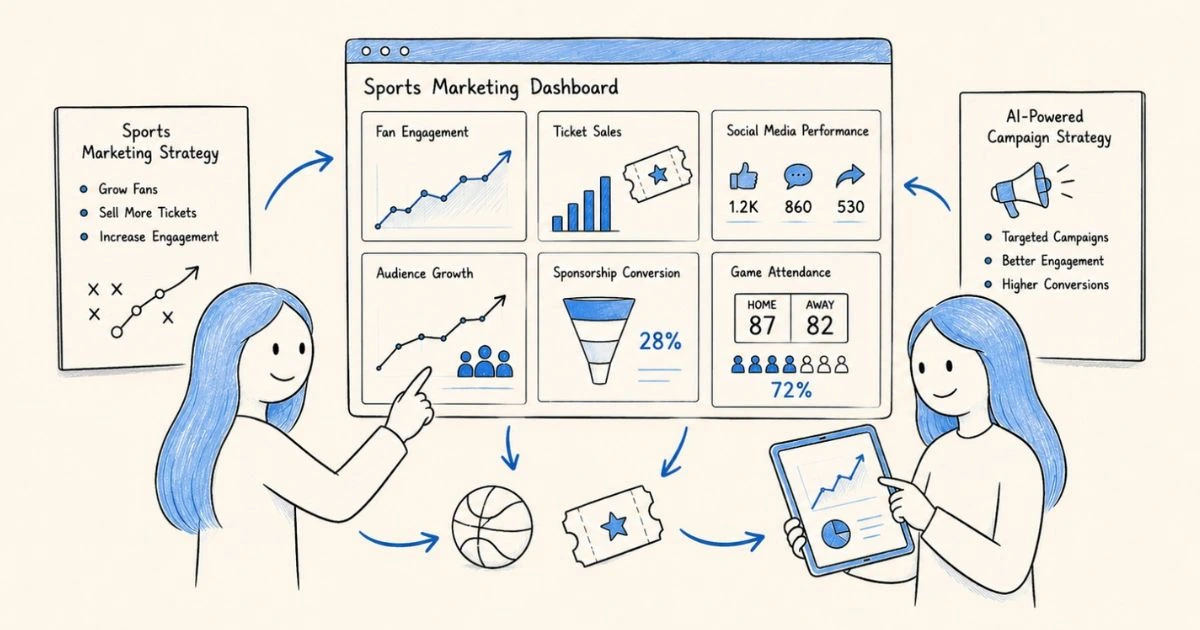
Sports marketing operates in one of the most emotionally charged categories in business. Fans don’t just consume sports — they identify with it, organise their weekends around it, and form communities built on shared allegiance. The challenge is harnessing that passion into sustainable commercial relationships: ticket sales, merchandise revenue, sponsorship, and the kind of community engagement that turns casual interest into lifelong loyalty. Whether you’re a professional club, an amateur league, a sports brand, a coaching business, or a sports facility, these 38 ideas cover what works across the commercial spectrum of sports marketing.
1. Build a Community-First Social Media Strategy
The most successful sports brands on social media are those that treat their channels as community platforms rather than broadcast media. Sharing fan content, celebrating supporter milestones, running polls about team selection, engaging with supporter reactions to match results, and showing the human side of athletes and staff all generate the engagement that algorithmic platforms reward. Sports fans are among the most active social media participants in any category — they want to participate in the conversation, not just receive content. A social media strategy that consistently invites participation rather than just publishing content generates a community that markets itself through shares, comments, and the organic conversation that brings new fans into the orbit of your club or brand.
2. Invest in Short-Form Video Around Match Days and Training
Match-day content — the build-up, the dressing room, the warm-up, the post-match reactions, the analysis — generates the highest organic reach in sports social media. Fans who can’t attend the game live experience it vicariously through well-produced short-form content. Training ground footage, tactical insights, athlete skill demonstrations, and behind-the-scenes access all generate strong engagement on Instagram Reels, TikTok, and YouTube Shorts. The clubs and sports brands that invest in a dedicated content team to capture and produce this content consistently outperform those that treat social media as an afterthought. Short-form video is the primary organic discovery mechanism for younger sports fans — the audience whose lifetime value is highest.
3. Develop a Youth Engagement Programme That Builds Lifelong Fans
A child who attends their first match with a parent and has a positive, memorable experience is a fan for life. Youth engagement programmes — discounted family tickets, dedicated youth fan sections, pre-match player meet-and-greets for young fans, school outreach programmes, and youth coaching days — build the next generation of paying supporters, volunteers, and advocates. The clubs that invest most in youth experience consistently have the strongest adult supporter bases twenty years later. Youth engagement is a long-term investment with a payback period measured in decades, but the alternative — a declining fan base as the existing one ages — is the most existential challenge facing many established sports clubs.
4. Build a Membership Programme That Offers Genuine Supporter Value
A structured membership or fan club programme — with tiered benefits, early ticket access, exclusive content, merchandise discounts, and events for members — converts casual supporters into committed, paying community members. The value of the programme should be genuine: early match ticket access is meaningfully valuable to fans of popular clubs; access to player events is genuinely exclusive; member-only content that provides real insight into the club is worth paying for. A well-designed membership programme generates predictable recurring revenue, builds a committed supporter base, and provides the first-party data (member contact details, preferences, attendance patterns) that enables sophisticated targeted marketing.
5. Develop Sponsorship Packages That Deliver Measurable Value for Partners
Sports sponsorship is a commercial relationship that requires demonstrable ROI for the sponsor. Beyond logo placement, develop sponsorship packages that include: audience reach data, social media content featuring the sponsor, on-day activations that engage fans with the brand, hospitality for the sponsor’s clients, digital content packages, and co-created community initiatives. Sponsors who can measure the impact of their investment in genuine business terms — new customers, brand recall, sales uplift — renew and increase their investment. Those who can’t measure ROI cancel. The sports organisations with the strongest commercial revenues are those with a sponsorship proposition built on measurable outcomes rather than brand exposure alone.
6. Use Email Marketing for Ticket Sales and Match Reminders
An email database of supporters — segmented by attendance history, membership status, and location — is the most reliable tool for driving ticket sales to specific fixtures. A ticket promotion email sent to supporters who attended the same fixture last season, with a personalised message acknowledging their loyalty and a direct booking link, consistently outperforms broad advertising for ticket sales. Email is also the most effective channel for communicating last-minute ticket availability, special offers on harder-to-sell fixtures, and priority access for cup or playoff matches. Sports clubs that build and maintain a segmented email database generate more predictable ticket revenue than those that rely on walk-up and social media promotion alone.
7. Create an Athletic Storytelling Content Programme
The personal stories of athletes — their backgrounds, their motivations, the challenges they’ve overcome, the communities they come from — are among the most compelling content in any sports marketing programme. Mini-documentaries, written profiles, and interview series that reveal the human being behind the athlete build the personal connection that drives merchandise sales, social media engagement, and the kind of emotional investment that sustains fan loyalty through difficult periods for the club or team. The athletes whose personal stories are most widely shared generate audiences that extend beyond the sport’s existing fanbase into mainstream media, music, and culture — reaching new demographics that traditional sports marketing doesn’t access.
8. Build a Women’s Sport or Junior Sport Programme With Its Own Marketing
Women’s sport and junior sport represent significant growth markets that most sports organisations still underinvest in commercially. A women’s team or junior programme with its own brand identity, dedicated social media presence, distinct sponsorship opportunities, and marketing tailored to its specific audience generates commercial value independently of the main team’s performance and attracts the new audiences, new sponsors, and community engagement that established properties often struggle to reach. The organisations that have invested earliest in women’s sport development are now reaping the commercial and community rewards as audiences, broadcast rights, and sponsorship values in women’s sport grow consistently.
9. Host Fan Events That Extend Engagement Beyond Match Days
A supporter relationship built entirely on match-day attendance is seasonal and fragile. Events that maintain engagement throughout the year — end-of-season awards dinners, pre-season fan forums, open training sessions, charity events, player Q&A evenings — keep fans connected to the club when there’s no competition to attend. These events also generate content, build personal relationships between fans and club staff, and create the sense of community that distinguishes a genuine club from a spectator sport. Supporters who attend non-match-day events are among the highest-value fan segments: more likely to renew season tickets, more likely to buy merchandise, and more likely to recruit new supporters from their own networks.
10. Develop a Data Strategy to Understand Your Fan Base
The sports organisations that make the best commercial decisions are those that understand who their fans are, how they engage, what they spend, and what they value. Building a first-party data strategy — collecting supporter data through membership, ticketing, app usage, and loyalty programmes, with proper consent — enables personalised marketing, smart venue capacity management, targeted sponsorship proposals, and merchandise range decisions grounded in actual demand rather than assumption. Data collection in sports is particularly powerful because fans are willing to share information in exchange for personalised benefits. The organisations that build this capability now will have a significant competitive advantage as the sports industry’s commercial sophistication increases.
11. Build a Digital Fan Engagement Platform or App
A dedicated club or league app — providing live match updates, behind-the-scenes content, exclusive supporter features, ticket management, and loyalty programme integration — creates a direct engagement channel that doesn’t depend on social media algorithm reach. Fans who download your app have opted into the deepest level of digital engagement available and can be reached directly with push notifications at match-relevant moments. Build the app around genuine utility — match day navigation, AR stadium experiences, interactive polls, and exclusive content — rather than as a brand asset. Apps that provide real value generate sustained engagement; those built primarily for marketing reach are quickly uninstalled.
12. Use Grassroots Sport Involvement to Build Community Presence
For professional clubs, supporting grassroots sport in your community — through coaching provision, kit donations, ground sharing, referee training, or community sports facility development — generates genuine goodwill that translates into supporter loyalty and sponsor attraction. A club that is visibly invested in the health of its local sporting ecosystem is a club that the community supports financially and emotionally through its own difficulties. Community sport investment also generates sustained press coverage from local media that commercial marketing rarely replicates and connects the professional club to the personal sporting memories and participation of thousands of local people.
13. Invest in Matchday Experience as a Marketing Asset
The matchday experience — from arrival and parking to the quality of the food and drink, the comfort of the seats, the pre-match entertainment, and the ease of leaving — determines whether first-time attendees become regular supporters more than any advertising campaign. A supporter who attends a match, has an excellent experience, and leaves wanting to return has been acquired as a long-term fan through the product itself. Audit every touchpoint of your matchday experience and ask: does this make someone more or less likely to return? Investment in matchday experience is the most powerful form of retention marketing available to a sports club or event — and its effects are cumulative over many seasons.
14. Build a Stadium or Facility That Is a Year-Round Venue
A sports venue that generates revenue only on match days is underutilised and commercially fragile. Events — concerts, corporate hospitality, weddings, conferences, community gatherings, school visits — transform the venue from a periodic asset into a commercial engine that generates revenue and brand presence throughout the calendar year. Market the venue specifically for events through a dedicated events page, hospitality packages tailored to corporate audiences, and partnerships with event planners and production companies. Venues that build a strong non-sport events business generate the commercial diversification that insulates sports organisations from the volatility of competitive results and seasons.
15. Create a Sports Performance Content Series for Social Discovery
Performance-focused content — training drills, biomechanical analysis, nutritional insights, athlete conditioning routines, and tactical breakdowns — attracts sports enthusiasts who may not currently be fans of your specific club or team but who are deeply interested in the sport. A content series that demonstrates athletic performance expertise reaches beyond the existing supporter base into the broader sport community, generating new followers who convert to fans as they engage more deeply. This type of content also attracts media attention from sports science publications, coaching communities, and the growing sports performance content ecosystem on YouTube and TikTok.
16. Develop a Corporate Hospitality Programme With Genuine Value
Corporate hospitality — sponsorship packages that include VIP matchday experiences for a sponsor’s clients — is a significant revenue stream for sports clubs and leagues at all commercial levels. The value of corporate hospitality lies in the experience it enables for the sponsor’s guests: access they couldn’t otherwise get, memories they associate with the sponsoring company, and the commercial relationship that the social context facilitates. Design hospitality packages that are genuinely memorable: access to players, exclusive venue areas, high-quality food and drink, and personalised hosting. Corporate clients who use hospitality to entertain their most important relationships will renew the partnership if those relationships benefit from the experience.
17. Use Athlete Social Media Profiles as a Collective Marketing Asset
The combined social media following of a club’s athlete roster is often significantly larger than the club’s own accounts. A strategic approach to athlete social media — supporting athletes with content, encouraging cross-tagging, creating collaborative content, and aligning athlete posting around key commercial and competitive moments — amplifies the club’s marketing reach through the athletes’ personal audiences. Athletes who have strong personal brands attract sponsors who value their individual reach as well as the club affiliation. A social media strategy that treats athlete profiles as a collective asset alongside official club channels generates a combined reach that no single marketing budget can replicate.
18. Build a Podcast Around Your Sport That Attracts New Audiences
A podcast built around your sport — tactical analysis, athlete interviews, history and culture of the game, fan perspectives — attracts listeners who are interested in the sport beyond the existing club supporter base. The barriers to entry for podcast production are low and the growth of sport podcast listenership is significant. A well-produced sports podcast builds the kind of intimate, extended engagement with an audience that generates the deep brand loyalty valuable to sponsors and the genuine emotional connection that converts listeners into event attendees. Monetise through sponsorship, merchandise promotion to the podcast audience, and live podcast event ticketing.
19. Run a Fantasy or Prediction League for Your Competition
Fantasy leagues, score prediction games, and player performance contests extend fan engagement throughout a season and give supporters a reason to be invested in every fixture, not just those involving their favourite club. These mechanics also generate significant data about fan preferences, engagement patterns, and demographics that inform commercial decisions. Fantasy leagues are sticky — fans who participate for three consecutive seasons are among the most commercially engaged in the sport. Integrate fantasy mechanics with your digital platform or app, link them to matchday ticket incentives (highest fantasy scorers win prizes at matches), and build them into your sponsor activation portfolio as an engagement vehicle.
20. Build a School Outreach Programme That Markets to Future Fans
Sports clubs that visit local schools — for coaching sessions, athlete appearances, educational programmes, or PE curriculum support — build brand awareness and personal connection with young audiences at the age when sporting allegiances form. The child who receives a visit from a professional athlete and spends an hour learning skills with them creates a personal memory associated with that club that shapes their sporting identity for years. School programmes also generate press coverage from local media and demonstrate the community investment that attracts sponsors who want to associate with socially positive initiatives. This is long-term fan acquisition at its most fundamental level.
21. Develop an International Fan Community for Global Sports
For sports clubs with international following, digital engagement with global fans — who cannot attend games in person but are passionate supporters — represents a significant commercial opportunity that most clubs still underserve. An international fan community strategy: localised social media content, online events in time zones accessible to international supporters, merchandise accessible and affordable for international shipping, and digital membership options that provide international fans genuine value. The global supporter who buys merchandise, watches broadcast content, and engages digitally represents real commercial value even without match attendance, and the clubs that cultivate these relationships find that international expansion of their supporter base generates broadcasting revenue, kit sales, and touring opportunities.
22. Partner With Health and Fitness Brands That Align With Your Values
Sports organisations have a natural alignment with health, fitness, and wellbeing brands that extends beyond logo placement. A genuine partnership with a nutrition brand, a fitness equipment company, a sports recovery specialist, or a health technology provider creates the kind of integrated commercial relationship that generates authentic content, mutual audience sharing, and the co-created activation that engages fans more deeply than a passive sponsorship arrangement. The most valuable sport brand partnerships are those built on genuine category alignment and a shared audience — where the sponsor’s product is one a genuine fan of the sport would actually use and benefit from.
23. Create a Branded Line of Athletic Training Content for Aspiring Participants
Content that helps people improve at the sport you represent — training programmes, skill tutorials, tactical guides, and fitness advice — attracts a broader audience than the existing fan and player base. Aspiring participants who use your training content develop a relationship with your brand at the exact moment their commitment to the sport is deepest. This content marketing approach works particularly well for sports organisations with strong coaching infrastructure and for sports brands with product lines tied to athletic performance. Training content viewers convert to ticket buyers, merchandise purchasers, and community members at higher rates than passive sports media consumers.
24. Use Countdown Campaigns to Build Anticipation for Major Fixtures
The build-up to a major fixture — a derby, a cup final, a promotion decider, a rivalry match — is one of the highest-engagement content periods in any sports calendar. A structured countdown campaign that begins weeks before the match, builds narrative tension through historical context, player profiles, tactical preview content, and fan anticipation content, and culminates in a matchday content surge generates the sustained engagement that drives ticket sales, merchandise purchases, and social sharing from fans who are emotionally invested in the outcome. The clubs that create the best big-match content campaigns consistently outperform those that leave the anticipation to happen organically.
25. Build a Merchandise Line That Extends Beyond the Core Supporter Base
A merchandise range limited to replica kits and club-branded basics serves only committed supporters. A merchandise line that includes lifestyle clothing, training apparel, accessories, and items with a distinctive aesthetic that extends beyond obvious club branding reaches a wider audience — urban lifestyle buyers, sports performance enthusiasts, and the fashion-adjacent consumer who would wear well-designed sports apparel without necessarily attending every game. Clubs and sports brands that invest in the design quality of their merchandise and position it within contemporary streetwear and lifestyle contexts generate merchandise revenue from audiences significantly broader than their match-attending supporter base.
26. Invest in a Sustainability Story and Environmental Commitment
Sports organisations occupy a unique position in their communities and carry significant influence over fan behaviour and attitudes. A genuine commitment to environmental sustainability — solar energy at the stadium, sustainable food sourcing, active travel initiatives, carbon offset programmes for away travel — is both the right thing to do and an increasingly important factor in sponsorship decisions. Sponsors are under mounting pressure to associate with organisations whose environmental values align with corporate ESG commitments. A genuine and well-communicated sustainability programme attracts sponsors, generates press coverage, and connects with the significant proportion of sports fans who rate environmental responsibility as an important factor in their purchasing and support decisions.
27. Create a Hall of Fame and Historical Archive That Celebrates Your Heritage
Every sports organisation with history has a heritage that represents a marketing asset. A hall of fame, a historical archive, a club museum, or a “greatest moments” content series celebrates the stories and personalities that have defined your organisation and connects older supporters to their memories while introducing new fans to the tradition they’re now part of. Heritage content consistently generates strong engagement from supporters of all ages. It also provides a foundation for anniversary campaigns, reunion events, and the kind of long-form documentary content that attracts media attention and streaming platform deals. An organisation that knows and celebrates its history signals institutional depth that is itself a commercial differentiator.
28. Develop an E-Sports or Gaming Strategy for Digital Fan Engagement
E-sports and gaming represent a significant cultural bridge between sports fandom and the digital entertainment that younger audiences spend most of their leisure time consuming. A professional club with an e-sports team, a gaming partnership with a major title, or a streaming presence on gaming platforms reaches the eighteen-to-thirty demographic most important for long-term fan base sustainability. E-sports marketing in traditional sport generates mainstream sports coverage, attracts gaming brand sponsorship, and provides a platform to develop the next generation of genuine sport supporters among an audience that the sport itself may not currently be reaching.
29. Build a Volunteer Programme That Creates Community Advocates
Volunteers who support a sports club — at events, at community programmes, in administration — develop a level of personal investment in the organisation’s success that no paid staff member can fully replicate. A well-run volunteer programme generates operational capacity, community connection, and a network of genuine advocates whose enthusiasm for the club extends throughout their personal and professional lives. Treat volunteers as valued community members: provide meaningful roles, recognise their contribution publicly, include them in club events, and build a culture where volunteering is seen as a genuine privilege rather than a burden. The volunteers who feel respected and connected become the club’s most effective word-of-mouth marketers in the surrounding community.
30. Engage Local Government and Community Partners for Facility Development
Sports facilities that are developed in genuine partnership with local government, community organisations, and educational institutions serve a broader community purpose that generates sustained public goodwill and the kind of cross-sector support that makes planning applications, funding bids, and community campaigns more successful. A sports club that positions itself as a community asset — providing facilities for schools, hosting community health initiatives, making the ground available for non-sporting events — builds the political and community relationships that are essential for the capital projects and planning approvals that determine long-term competitive and commercial capability.
31. Use Geofencing and Location-Based Marketing for Match Day Activation
Geofencing technology allows you to serve mobile advertisements to anyone who enters a defined geographic area — the vicinity of your stadium, the local area around an away venue, or the catchment area of a retail partner on match day. A matchday geofencing campaign promoting last-minute ticket availability, a special match-day food and drink offer, or a merchandise promotion reaches the most immediately relevant audience — people who are physically close to the match — at the most relevant moment. Location-based marketing is a component of a match-day commercial strategy, not a standalone channel, but it consistently generates measurable incremental revenue from the audience that is already in proximity.
32. Build a Broadcasting and Media Strategy for Rights Not Held by Broadcasters
The content rights not covered by broadcast agreements — training footage, behind-the-scenes access, athlete personal content, fan interaction content — represent significant digital media opportunity that clubs and sports organisations frequently leave undeveloped. Building an owned media strategy for this content — a YouTube channel with consistent high-quality programming, a club TV streaming service, a podcast network — generates advertising revenue, sponsorship opportunities, and global fan engagement that the primary broadcast relationship doesn’t reach. The clubs with the largest owned media audiences have built commercial models that are partially independent of broadcast rights revenue, which provides strategic resilience as the sports media landscape evolves.
33. Create a Campaign Around a Social Cause Aligned With Your Values
Sports organisations that take visible, consistent positions on social issues — anti-discrimination, mental health awareness, community inclusion, disability sport — connect with audiences who care about those causes as much as the sport itself. The most effective cause campaigns are those where the commitment is genuine and sustained rather than a one-off activation: ongoing partnerships with relevant charities, athlete-led advocacy, policy positions backed by visible action, and community programmes that deliver real impact. Genuine cause alignment attracts sponsor partners who share those values, generates media coverage, and builds the emotional connection with supporters that transcends competitive performance.
34. Run a Season Launch Campaign That Creates Anticipation and Sells Tickets
The launch of a new season is the highest anticipation moment in any sports organisation’s calendar — an opportunity to reactivate lapsed supporters, attract new ones, and drive early season ticket sales before the competitive reality sets in. A well-designed season launch campaign: a narrative built around the season’s ambitions, new signing introductions, behind-the-scenes pre-season content, a launch event for members and press, and a targeted email campaign to the entire supporter database with a genuine early-bird incentive. The clubs that generate the highest early season ticket sales are those that build genuine excitement around the possibility of the season ahead, not just the facts of squad assembly.
35. Develop a Jersey and Kit Story That Creates Cultural Significance
A club or national team kit is far more than a uniform — it’s a cultural artefact that carries the weight of historical moments, community identity, and personal memory. Investing in the story of a new kit — the design inspiration, the heritage references, the community consultation, the cultural collaborations — turns a commercial product launch into a genuine cultural moment that generates press coverage, social media conversation, and the kind of emotional engagement that drives merchandise sales beyond the committed supporter base. Kits that carry a narrative consistently outsell those that are released without context, and the best kit launches have become media events that generate coverage far beyond the sports pages.
36. Build a Cricket, Rugby, or Football Camp Business That Markets the Club
Sports camps — holiday coaching programmes for children and young people — are simultaneously a revenue stream and a marketing channel. A child who spends three days being coached by staff from their favourite club and meeting players at the end develops a personal connection with the organisation that no advertisement can manufacture. Camp participants become the most enthusiastic junior supporters, bring their parents to matches, and recruit their friends into the supporter base. Sports camps also generate consistent press coverage and serve as a visible demonstration of the club’s community investment. The commercial margin on well-run camps is positive, making them one of the genuinely dual-purpose commercial and marketing activities available to sports organisations.
37. Invest in Sports Analytics and Share Insights Publicly
Data and analytics content in sports — performance statistics, tactical breakdowns, historical trend analysis — attracts the analytically minded sports fans who are among the most engaged and commercially valuable in any supporter base. A club or sports organisation that publishes genuine analytical insights about the sport — not just match statistics but meaningful performance context — positions itself as an intellectually credible voice in the sporting conversation. This content attracts media coverage from sports analytics publications, engagement from coaching and performance communities, and the kind of social sharing among sports-savvy fans that reaches into professional networks well beyond the traditional fan base.
38. Measure Fan Lifetime Value and Build Marketing Around Retention
The fan who attends their first match at age eight and maintains their connection with a club for sixty years represents an extraordinarily different commercial value from the casual attendee who comes twice and doesn’t return. Understanding fan lifetime value — modelling what a supporter who retains through youth, teenage, and adult life is worth commercially across ticket sales, merchandise, digital engagement, and hospitality — changes how you allocate marketing investment. The organisations that understand this invest heavily in youth acquisition, junior supporter experience, and the touchpoints that maintain connection through the life stages when sporting loyalty is most vulnerable to drift. Fan retention is the most important and most underinvested area of sports marketing.