Hotel marketing has never been more competitive — or more nuanced. OTAs take a commission on every booking they generate while training guests to book through platforms rather than direct. Review sites can make or break a property overnight. And travellers today research across six or seven touchpoints before confirming a reservation. The hotels that win in this environment are those with a clear point of difference, genuine direct booking relationships, and marketing that makes the property’s character compelling before a guest arrives. These 33 ideas cover what works, from digital fundamentals to the experience design that turns guests into advocates.
1. Claim and Optimise Your Google Business Profile Completely
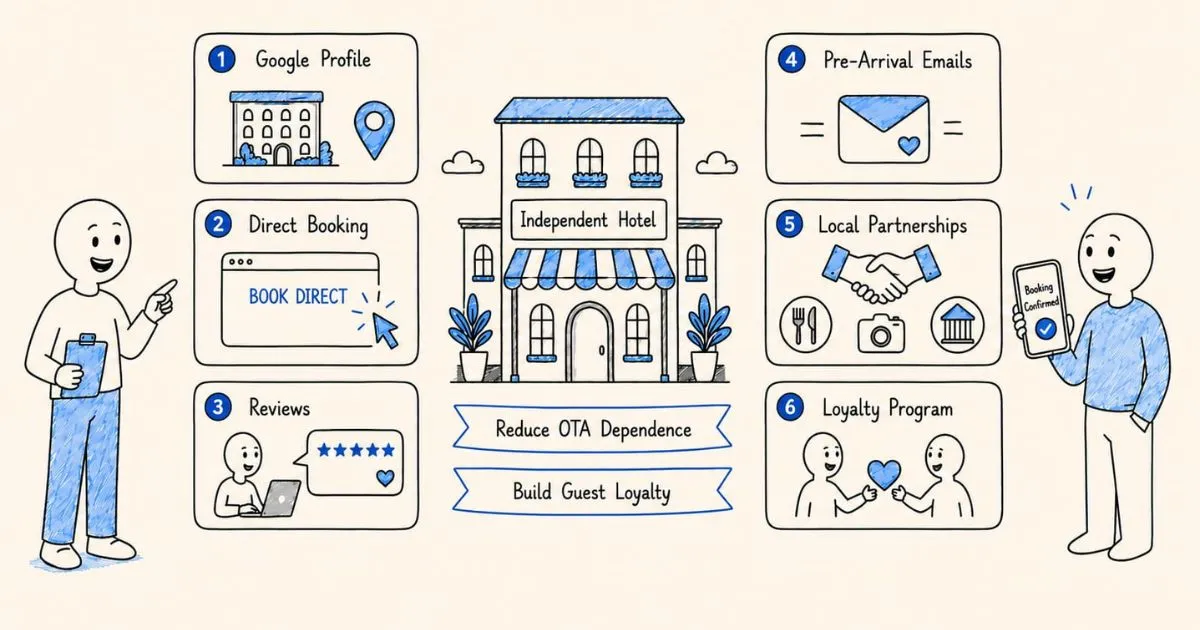
When a traveller searches for hotels in your area, your Google Business Profile determines whether you appear, how prominently, and how compelling you look when you do. Fill in every field: address, phone, website, check-in and check-out times, parking details, amenities, and a keyword-rich description. Upload at least thirty high-quality photos including rooms, common areas, dining, and exterior. Post weekly updates. Enable messaging. Enable booking links directly to your website. An optimised Google Business Profile generates more direct calls, website visits, and bookings than any other free marketing activity available to a hotel.
2. Prioritise Direct Booking With Genuine Incentives
OTA bookings are expensive — commission rates of 15–25% mean that every OTA booking costs significantly more than a direct one. Build a compelling direct booking case on your website: price match guarantee, free room upgrade on availability, complimentary breakfast, flexible cancellation terms, or early check-in as direct-booking exclusives. Display these benefits prominently on your website and in your advertising. The goal is to give the traveller a genuine reason to book direct that they can’t get through Booking.com or Expedia. Hotels with an active direct booking incentive programme consistently reduce their OTA dependency over time without sacrificing occupancy.
3. Invest in Professional Photography That Sells the Experience
Hotel photography is the single most influential factor in online booking conversion. Images that show the warmth of a well-lit bedroom, the character of a distinctive common space, or the mood of a terrace at golden hour create desire in a way that floor plans and amenity lists never can. Hire a professional hospitality photographer for a full day shoot at least once per year. Use the full range of shots — hero exterior, room types, dining, details, and lifestyle shots with people enjoying the space — across your website, OTA listings, social media, and advertising. Poor hotel photography costs far more in lost bookings than the investment in getting it right.
4. Build a Strong Presence on TripAdvisor and Respond to Every Review
TripAdvisor remains the world’s largest travel review platform and a primary research destination for travellers making booking decisions. Your TripAdvisor ranking in your destination is a direct marketing asset — properties in the top ten for their area generate substantially more enquiries than those outside it. Systematically encourage guests to leave reviews immediately after checkout via email, in-room card, or direct ask at departure. Respond to every review — positive and negative — professionally, personally, and promptly. The response demonstrates to future readers that you take guest feedback seriously, which converts undecided travellers at measurably higher rates.
5. Develop a Loyalty Programme for Direct Bookers
A simple loyalty programme for guests who book direct — a free night after five stays, room upgrades, priority check-in, complimentary extras — creates a specific ongoing reason for repeat guests to bypass OTAs. Unlike the OTA loyalty programmes that accumulate points across thousands of properties, your direct loyalty programme offers something more personal: a genuine relationship with a specific property. For independent hotels and small groups, this personal dimension is a competitive advantage over both OTAs and the major chains. Email your loyalty members with exclusive offers before publishing availability more broadly, and treat them visibly as valued guests on arrival.
6. Create Destination Content That Builds Organic Search Traffic
Travellers researching a destination search for far more than hotels — they search for things to do, where to eat, seasonal events, local hidden gems, and practical travel information. A hotel that publishes genuinely useful destination content — “the best day trips from [your city],” “where locals eat in [your neighbourhood],” “the best time of year to visit [your destination]” — attracts organic search traffic from travellers in the research phase, before they’ve chosen accommodation. This content positions your property as a local expert and keeps your website in front of potential guests throughout their destination research process, not just at the booking stage.
7. Run Google Hotel Ads and Search Campaigns for Direct Booking Keywords
Google Hotel Ads place your direct booking rate in Google’s hotel search results alongside OTA rates, allowing travellers to book directly from the search results page. For properties with a competitive direct booking rate, Google Hotel Ads generate direct bookings at a significantly lower cost than OTA commission. Supplement with search ads targeting branded terms (your hotel name) to capture travellers who found you on an OTA but searched for you directly before booking. The combination of Hotel Ads and branded search protection ensures you capture direct bookings from guests who are already motivated to stay with you.
8. Use Instagram and Pinterest to Showcase the Visual Appeal of Your Property
Travel is one of Instagram and Pinterest’s strongest content categories — users actively seek inspiration and save properties they want to visit. A consistent, beautiful Instagram presence showcasing your property’s most photogenic elements, the local destination, and the experience of staying with you builds an audience of potential future guests over time. Feature user-generated content from guests who tag your property. Use Instagram Stories for real-time destination content. Pinterest boards organised by travel inspiration, room types, and local attractions generate long-term organic traffic from travellers in the inspiration phase of their journey planning.
9. Build a Pre-Arrival Email Sequence That Increases Revenue and Satisfaction
The period between booking and arrival is a significant revenue and relationship opportunity that most hotels underuse. A pre-arrival email sequence — confirmation plus upsell at booking, welcome email seven days before arrival with local recommendations, and a “your stay starts soon” email two days before — generates meaningful incremental revenue from room upgrades, dining reservations, spa bookings, and local experiences. It also reduces no-shows and check-in friction. Guests who arrive having already engaged with your pre-arrival communication report higher satisfaction scores because their expectations are well-managed before they step through the door.
10. Partner With Local Attractions, Restaurants, and Experiences
Partnerships with local restaurants, tour operators, cultural attractions, and unique local experiences allow you to offer curated packages that OTAs can’t replicate. A hotel that can offer guests an exclusive evening at a local Michelin-starred restaurant, a private guided tour, or a behind-the-scenes cultural experience is differentiated in a way that rate-matching never achieves. These partnerships are often relatively easy to establish — local businesses benefit from hotel referrals, and you benefit from the exclusivity and the experience depth it adds to your offering. Package these partnerships into bookable add-ons and promote them throughout your marketing funnel.
11. Develop a Corporate Account Programme for Local Business Travel
Local companies whose employees travel regularly — for meetings, for relocating staff, for hosting clients — represent a consistent, high-value demand segment that most independent hotels underinvest in reaching. A corporate account programme with negotiated rates, a dedicated point of contact, invoice billing, and flexible cancellation terms turns occasional business travellers into a reliable revenue stream. Identify the twenty to thirty companies in your catchment area with regular travel needs, introduce yourself in person, and offer a tailored arrangement. Corporate accounts generate lower-cost bookings than OTA leisure bookings and produce more consistent occupancy through the shoulder periods when leisure demand is softest.
12. Run Social Media Competitions to Generate Email Leads
A well-structured social media competition — “win a two-night stay for two including dinner” — generates email sign-ups, social followers, and brand awareness among audiences who may not have encountered your property before. The key is structuring the competition to require email opt-in for entry, so that the audience you build is accessible beyond the platform. Follow up competition entrants who didn’t win with a “consolation offer” — a modest direct booking discount — immediately after the result. A competition run quarterly generates a sustained flow of new email subscribers who have already demonstrated interest in staying at your property.
13. Create a Wedding and Events Offer That Markets Itself
Weddings and private events are among the highest-value bookings an independent hotel can generate — and a couple who hosted their wedding at your property becomes an ambassador for life, recommending you to their network for every future stay and event. Build a dedicated wedding offer with its own page, clear pricing, real photography from actual events, and testimonials from couples. List your property on wedding directories such as Hitched, Bridebook, and Rock My Wedding. The investment in wedding marketing pays back not just in event revenue but in the sustained stream of leisure bookings from guests who attended events and want to return.
14. Use Retargeting Ads to Recover Abandoned Booking Sessions
A significant proportion of travellers who visit your booking engine and begin a reservation abandon before completing it. Retargeting campaigns — served on Google Display, Facebook, and Instagram — bring these travellers back with a reminder of the property and, where appropriate, a time-sensitive incentive to complete their booking. Retargeting audiences are among the most valuable in hotel marketing because they’ve already demonstrated strong intent: they visited your website, searched for availability, and selected dates. A well-designed retargeting sequence recovers a meaningful percentage of these abandoned sessions at a fraction of the cost of acquiring new visitors.
15. Build Your Email Database and Use It for Yield Management
An engaged email database of past and interested guests is the most cost-efficient tool available for filling specific periods of low occupancy. A targeted email to your database — “we have exceptional availability for this weekend; here’s a rate that won’t be available anywhere else” — generates direct bookings from warm contacts at far lower cost than last-minute OTA promotions. Build your list systematically: capture every guest email at check-in and checkout, offer a value exchange (an exclusive rate, a local guide) for new subscribers, and email your list at least twice per month with a genuine reason to visit. Volume and recency both matter for email marketing effectiveness.
16. Create a Strong “About” Story That Makes Your Property Memorable
Independent hotels have a story — a founding family, a historic building, a design vision, a chef with a culinary philosophy — that chain hotels can never replicate. That story is a marketing asset. Tell it vividly on your website, in your room collateral, in your email communications, and in your social media. The travellers who choose an independent hotel over a chain are often explicitly seeking character and authenticity — your story is what they’re paying for as much as the bed. Hotels that communicate their story compellingly retain guests better, generate more word-of-mouth recommendations, and command higher rates than equivalent properties without a strong narrative identity.
17. List on Boutique Hotel Platforms That Drive Premium Bookings
Beyond the major OTAs, platforms like Mr & Mrs Smith, i-escape, Tablet Hotels, and Design Hotels attract affluent, design-conscious travellers who are specifically seeking distinctive, characterful properties. Acceptance onto these curated platforms requires meeting quality standards, but the customers they deliver book at higher rates, spend more on food and beverage, and are more likely to return and refer than OTA leisure customers. Apply to the platforms most appropriate to your positioning and invest in a high-quality property profile on each. Curated platform traffic costs commission but delivers a customer quality that justifies the cost over the guest lifetime.
18. Publish a Monthly Newsletter With Genuine Destination Value
A monthly email to your subscriber database isn’t just a marketing exercise — it’s relationship maintenance with guests who enjoyed their stay and might return, or who might not have stayed yet but are interested in your destination. Fill it with genuinely useful destination content: seasonal events, new restaurant recommendations, local festivals, and insider tips from your team. Include a direct booking offer as a natural extension of the value content rather than as the primary purpose. Subscribers who receive genuinely useful destination information from a hotel they trust book direct at significantly higher rates than those who receive only promotional emails.
19. Invest in Your Food and Beverage Offer as a Marketing Asset
A hotel restaurant or bar that attracts local guests — not just hotel residents — transforms the property into a community venue with a continuous stream of local advocates who recommend it to visiting friends and colleagues. A bar programme that’s the best in your neighbourhood, or a Sunday lunch that locals prioritise over dedicated restaurants, generates the kind of organic community word-of-mouth that no advertising can replicate. Invest in the food and beverage offer, give it its own social media presence, market it separately to local audiences, and use it as a reason for past guests to return even when they’re not travelling.
20. Capture and Leverage Video Content From Your Property
Short-form video is the fastest way to communicate the atmosphere and character of a hotel to a potential guest. A thirty-second walk-through of your most distinctive room, a time-lapse of your restaurant filling on a Saturday evening, a behind-the-scenes with your head chef, or a guest’s reaction to a view from your rooftop — these videos communicate what no static image can. Post consistently to Instagram Reels and TikTok. Invest in one monthly professionally shot video and supplement with daily authentic content. Hotels that are consistently active in video content report meaningfully higher levels of direct booking enquiries from social platforms within six months of starting.
21. Get Featured in Travel Publications and Guidebooks
A listing in a respected travel guidebook or a feature in a major travel publication provides third-party endorsement that travellers trust and that search engines value through backlinks. Build a target list of travel publications, bloggers, and guidebook editors who cover your destination and your property type. Offer hosted stays with no editorial conditions and genuine hospitality rather than a formal PR arrangement. The properties that consistently receive media coverage are those that make journalists and bloggers feel genuinely hosted rather than managed, and that provide the kind of distinctive experience worth writing about.
22. Monitor Your Rate Parity Across OTA Platforms
Rate parity violations — OTAs displaying rates below your direct rate through discount practices, net rates being resold, or membership discounts that undercut your direct offer — are one of the primary reasons direct booking incentives fail. Audit your rates across all OTA platforms weekly using a rate shopping tool or manual checks. When you identify parity violations, address them with the OTA account manager promptly. A traveller who sees your hotel listed cheaper on Booking.com than on your own site has no reason to book direct. Rate parity management is as much a marketing function as a revenue function.
23. Build a Spa and Wellness Day Package Marketed Locally
Hotels with spa facilities can generate significant revenue from local day visitors — people who want a spa day without overnight accommodation. A well-packaged spa day offer, marketed locally through social media, local lifestyle press, and Google advertising, generates midweek revenue from an audience that doesn’t require accommodation marketing. Spa day packages also serve as a gateway booking: guests who enjoy the spa as a day visitor become more likely to book overnight stays. Market spa packages separately from room offers and target specifically the local health and wellness audience who will never book a hotel room but will absolutely book a spa day.
24. Use Guest Feedback Surveys to Improve and to Generate Review Content
A post-stay survey — sent within 24 hours of checkout — captures feedback when the experience is fresh and gives guests who had a minor issue the opportunity to tell you before they tell TripAdvisor. For guests who report high satisfaction, the survey is also the moment to ask for a public review with a direct link. Analyse feedback quarterly to identify patterns: recurring positives that should be amplified in your marketing, recurring negatives that require operational attention. Hotels that systematically collect and act on guest feedback improve faster, have higher review scores, and generate more word-of-mouth recommendations than those that treat feedback as an administrative task.
25. Create Seasonal Packages That Drive Bookings in Shoulder Periods
The periods between your peak seasons are where most hotels feel occupancy pressure most acutely. Seasonal packages — a winter warmer escape, a spring walking weekend, an autumn food and wine offer — create bookable reasons to stay during periods when there’s no natural demand driver. Design packages around what makes your destination genuinely appealing in each season: autumn foliage, spring wildlife, winter cosiness, summer gardens. Price them attractively, promote them specifically to your email list and social following, and treat them as mini-campaigns rather than just rate adjustments. Shoulder-period packages generate incremental revenue from guests who needed a reason to choose that time of year.
26. Train Frontline Staff to Actively Request Direct Bookings for Future Stays
Every guest checking out is a potential future direct booker. A simple, genuine conversation from a member of your front desk team — “We’d love to have you back; if you book directly with us next time, we can offer you [a specific benefit]” — is one of the most effective direct booking tools available. Train your team to have this conversation naturally, not as a scripted sales pitch. Provide them with a specific, genuine benefit to offer, and make the direct booking process genuinely easy to explain. Guests who have just had a good stay are in the highest-possible-intent state to book again — meeting them at that moment costs nothing beyond the training.
27. Build a Presence at Corporate Travel Events and Industry Networks
Travel managers at large corporations, PA networks, and corporate event planners are the gatekeepers to the business travel market. Being present at the events and networks where these decision-makers gather — Corporate Travel Management events, PA association meetings, conference organiser networks — builds the relationships that generate contracted corporate rates and event bookings. One well-managed relationship with a corporate travel manager at a local company can be worth tens of thousands in annual room nights. The investment in corporate relationship marketing is the highest-return B2B activity available to most hotels.
28. Develop a Social Media Content Calendar Around Local Events
Every local festival, cultural event, sporting fixture, theatre season, and holiday period is a content opportunity and a demand driver. A social media content calendar built around your destination’s event calendar ensures you’re publishing relevant content in the weeks before major events, positioning your hotel as the natural accommodation choice. “Join us for the [local festival] — rooms still available this weekend” performs significantly better than generic hotel promotions because it’s connected to something people already want to do. Build the calendar six months in advance and plan your content and offers around the events that drive demand to your area.
29. Create a Memorable In-Room Experience That Drives Social Sharing
A guest who photographs something delightful in their room and shares it on Instagram is providing unpaid marketing to their entire network. Design your in-room experience with social sharing in mind: a personalised welcome amenity, a handwritten note that references something from their booking, an unexpected detail in the room decor, or a pillow gift that connects to local culture. These small moments cost relatively little and generate the authentic organic content that showcases your property’s personality far more compellingly than any brand-produced photography. The hotels most frequently tagged on Instagram are those that deliberately create experiences worth sharing.
30. Monitor and Manage Your Presence on Booking Platforms Rigorously
Your OTA listings are marketing assets that require regular attention. Photos should be refreshed when new photography is produced. Descriptions should be updated when facilities or policies change. Review responses should be current and personalised. Room categories should be accurately described with benefits-led copy rather than technical specifications. The hotel that treats its OTA listings as low-priority back-office administration loses bookings to competitors who maintain compelling, current, and accurate profiles. Dedicate thirty minutes weekly to auditing and improving your OTA presence across every platform on which you’re listed.
31. Build a Revenue Management Practice That Supports Marketing Goals
Dynamic pricing — adjusting rates based on demand, competitive set pricing, lead time, and event-driven peaks — allows you to maximise revenue during high-demand periods and stimulate demand during slow ones. A revenue management approach that’s integrated with your marketing means that when pricing creates availability pressure, marketing is activated to fill it, and when marketing drives demand spikes, pricing captures the value. Most independent hotels underinvest in revenue management tools and expertise, leaving money on the table during peak periods and failing to stimulate demand effectively during low ones. The combination of good marketing and disciplined revenue management outperforms either in isolation.
32. Use Influencer Marketing Strategically for New Property Launches and Renovations
When a property launches, reopens after renovation, or introduces a significant new facility, influencer marketing delivers the broad, immediate awareness that established hotels can generate through their existing guest database but new or newly repositioned properties cannot. A carefully selected group of travel influencers — those whose audience demographic and travel style aligns with your target guest — can generate significant visibility for a property in a short window. Choose influencers based on audience quality rather than follower count, require content that genuinely reflects the property rather than a scripted script, and ensure influencer content is clearly disclosed. Measure the campaign against bookings from influencer-originated traffic, not just impressions.
33. Measure Marketing ROI at the Channel and Campaign Level
Hotel marketing spending without measurement is spending without accountability. Track bookings by source — OTA, direct website, phone, walk-in, corporate account, email campaign, social media ad — and calculate the true cost per booking for each channel including OTA commission, advertising spend, and any incentives offered. Review this data monthly and quarterly. The channels generating the highest-quality bookings at the lowest net cost deserve increased investment. Those generating volume without profitability deserve scrutiny. Hotels that build a rigorous marketing measurement practice make better budget decisions, reduce OTA dependency over time, and grow direct revenue as a proportion of total bookings in a sustained and compounding way.