Beauty is one of the most dynamic marketing environments on the planet. The global beauty and personal care market is projected to reach $758 billion by 2026, according to Statista, driven by a generation of consumers who treat skincare as a wellness practice, makeup as self-expression, and brand loyalty as conditional on authenticity. The marketing channels have fragmented just as dramatically as the product landscape. TikTok discovers trends overnight. Dermatologist-backed content moves clinical skincare into mass market consciousness. AI generates personalised shade recommendations. And the traditional beauty counter — the brand’s most powerful experiential channel — competes with a consumer who has already watched forty-seven tutorials on the product they’re considering. Here are the 13 trends defining beauty marketing in 2026.
1. Skin Science and Ingredient Transparency
The beauty consumer of 2026 reads ingredient lists. They know the difference between retinol and retinal. They understand that niacinamide and vitamin C require sequencing. This shift — from aspirational marketing to informed ingredient-led purchasing — has fundamentally changed what beauty brands need to communicate and how they communicate it. Brands that previously sold the dream of transformation through lifestyle imagery are now selling the mechanism of action through education. The Inkey List, Paula’s Choice, and The Ordinary built their category positions on ingredient transparency, and the market has followed them.
The marketing implication is that ingredient education has become a primary acquisition channel. Brands running ingredient explainer series on TikTok and Instagram — breaking down exactly how their formulas work at the molecular level — are outperforming brands whose content is purely aspirational. Mintel’s 2025 Beauty Trends report found that 74% of skincare buyers aged 25–44 research active ingredients before purchasing, and 61% say they trust a brand more if it proactively explains what its formulas contain and why. Dermatologist partnerships, clinical trial result disclosures, and third-party testing certifications are no longer just credibility signals — they are conversion tools that directly influence purchase decisions at the point of research. The brands winning in premium skincare are those that have built a content architecture around ingredient education that converts search traffic into purchasers who understand precisely what they’re buying.
2. TikTok Shop and Social Commerce Integration
TikTok Shop has become a material revenue channel for beauty brands in 2026, collapsing the distance between discovery and purchase to near zero. A user watching a skincare tutorial can purchase the featured serum without leaving the app — and an increasing number are. TikTok’s own commerce data reports that beauty and personal care is the fastest-growing product category on its shopping platform, with conversion rates from in-app purchase prompts running three to four times higher than equivalent social advertising driving to an external website. The psychology is straightforward: when desire is created in-content, the purchase impulse is strongest at that exact moment. Introducing a redirect breaks the momentum.
Brands that have built TikTok Shop as a primary channel have restructured their influencer and affiliate programmes accordingly. Rather than traditional sponsored posts, they’re running affiliate commissions through TikTok’s creator marketplace — incentivising creators to drive direct in-app purchases rather than link-in-bio traffic. The result is attribution clarity that brand awareness campaigns never delivered: every creator-driven sale is tracked. The brands reporting the highest TikTok Shop revenue are those that have leaned into live shopping — QVC-style real-time selling sessions where creators demonstrate products, answer viewer questions, and drive purchases with limited-time discount codes. Live beauty shopping events with top creators regularly generate six figures in single sessions, with engagement and conversion rates that paid advertising cannot replicate.
3. Inclusive Beauty Beyond Token Representation
The inclusive beauty movement that began with Fenty Beauty’s 40-shade foundation range in 2017 has matured in 2026 into a market expectation rather than a differentiator. Brands that launched with narrow shade ranges have faced sustained commercial and reputational consequences. But inclusion in 2026 extends beyond foundation matching — it encompasses marketing imagery, campaign casting, product formulation for diverse hair textures and skin types, pricing accessibility, and representation in brand leadership and creative direction. Consumers, particularly younger ones, are auditing brands holistically and withdrawing loyalty when the gap between stated values and operational reality becomes visible.
The marketing opportunity in genuine inclusion is significant. Brands that have authentically expanded their representation — not through campaign-specific diversity casting but through sustained cultural investment — are accessing market segments that were previously underserved and correspondingly loyal. Black haircare, South Asian skincare, and products designed for mature skin are among the fastest-growing beauty subcategories, with consumers in these segments demonstrating above-average brand loyalty when they find products that actually address their specific needs. The brands winning in these segments are not the legacy houses that diversified late — they’re the independent brands that were built for these consumers from the ground up. Large incumbents face the authentic challenge of demonstrating that inclusion is structural rather than cosmetic, which requires genuine leadership diversity, community investment, and product development input from the communities they’re attempting to serve.
4. Micro-Influencer Beauty Ecosystems
The era of the beauty mega-influencer as primary marketing channel is declining. Brand deals with talent who have 5 to 10 million followers cost between $50,000 and $500,000 per post, with engagement rates that have fallen dramatically as audiences have grown more sceptical of obvious sponsorship. The strategic shift — already well underway in 2025 and accelerating in 2026 — is toward micro-influencer ecosystems: networks of 50 to 200 creators with 10,000 to 100,000 followers whose audiences are highly specific and whose recommendation credibility remains intact because they haven’t diluted it with constant brand deals.
Influencer Marketing Hub data shows micro-influencer beauty content generates engagement rates six times higher than macro-influencer content, with purchase intent scores that are consistently superior for product categories requiring trust — skincare, haircare, and specialist treatments in particular. The cost efficiency is compelling: the same budget that buys one post from a top-tier creator can fund a month-long micro-influencer campaign reaching a combined audience of similar size with far higher conversion probability. Brands running structured micro-influencer programmes — providing products, detailed briefing on key claims, and performance-based fee structures — are treating this as a performance marketing channel rather than a PR activity, with the attribution rigour that implies. The most sophisticated programmes have moved beyond one-off seeding to long-term ambassador relationships that develop genuine product expertise and audience trust over months.
5. Personalisation at Scale — AI Skin and Shade Matching
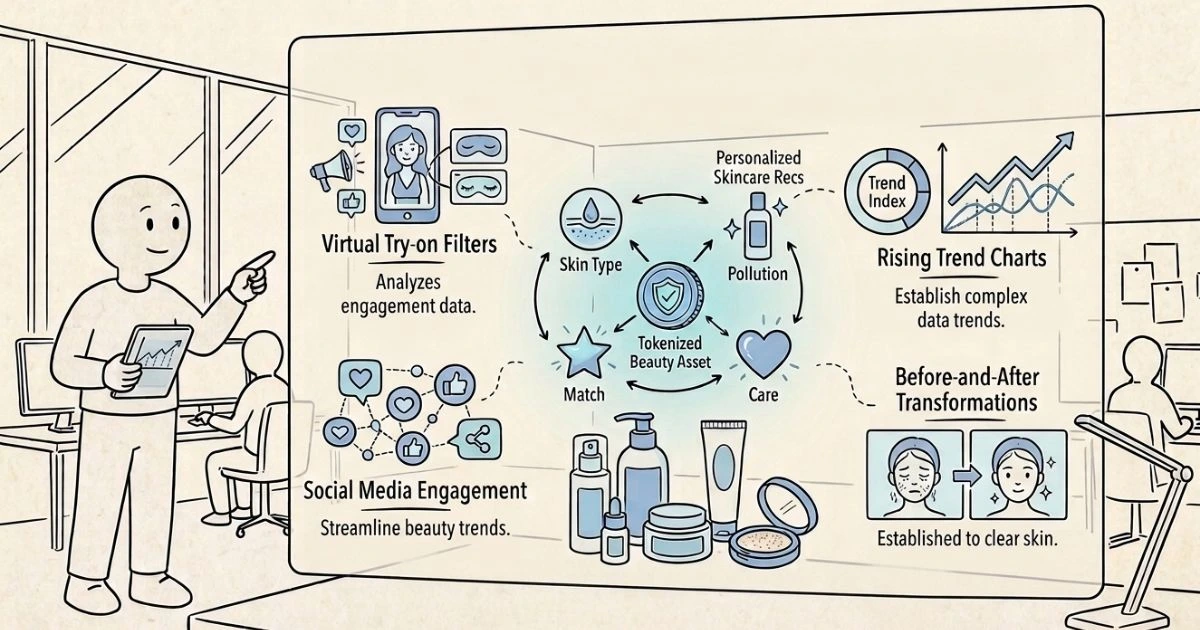
Personalisation in beauty has crossed from concept to expectation. AI-powered shade matching, skin analysis tools, and customised formulation services are now live across major beauty retailers and brand DTC platforms. L’Oréal’s Style My Hair and ModiFace acquisition, Sephora’s Virtual Artist, and dozens of independent beauty tech platforms allow consumers to try products virtually, receive personalised recommendations based on skin type analysis, and in some cases order products formulated specifically for their individual needs. McKinsey found that beauty consumers who engage with personalisation tools convert at 2.5 times the rate of those who browse without them.
The marketing value of personalisation extends beyond the transaction. Brands that collect first-party preference data through personalisation tools build customer profiles that enable genuinely relevant communication at every subsequent touchpoint — restocking reminders timed to product usage cycles, complementary product recommendations based on existing routine, and skin progress tracking that creates emotional connection to the brand journey. The data flywheel is powerful: more personalisation usage generates more data, which improves recommendation quality, which drives more usage. Brands that have invested in personalisation infrastructure are building retention advantages that are difficult for competitors to replicate. The personalisation tools that perform best are those that integrate seamlessly into the shopping journey rather than existing as standalone features — a skin analysis that lives on the product page converts more than one that requires a separate app download.
6. Clean Beauty and Regulatory Compliance as Marketing
The clean beauty movement has evolved from a vague aspiration into a legally significant category in several major markets. The European Union’s updated Cosmetic Regulation framework, California’s Cosmetic Fragrance and Flavor Ingredient Right to Know Act, and a growing wave of state-level ingredient restrictions have transformed “clean” from a marketing claim into a regulatory reality. Brands that built genuine clean formulation practices ahead of these regulatory shifts are now able to market compliance as a competitive advantage rather than scramble to reformulate existing products.
Consumer trust in clean beauty claims is sophisticated and sceptical. Greenwashing — marketing environmental or health credentials that don’t withstand scrutiny — has been widely documented and widely publicised, and consumers in the 25–45 demographic in particular apply rigorous interrogation to clean claims. The brands winning in this space are those with third-party certifications (EWG Verified, COSMOS Organic, Leaping Bunny) that provide independent verification, and those that publish full ingredient transparency including fragrance component disclosure. Clean beauty marketing that works is specific rather than aspirational: “formulated without the 1,400 ingredients banned by the EU” is more credible than “clean and natural.” The operational investment required to achieve genuine clean compliance is significant, but the brands that have made it are building defensible market positions in a category that regulatory momentum is making mandatory rather than optional.
7. Experiential Retail and Phygital Beauty
Beauty retail that survives in 2026 does something that e-commerce cannot: it creates a sensory experience that builds emotional connection and enables genuine product trial. The beauty brands investing in experiential retail are not replicating the traditional department store counter — they’re creating immersive environments where consumers learn, experiment, and connect with community. Aesop stores are designed as environmental art installations. Charlotte Tilbury’s retail concept centres on theatrical transformation experiences. Glossier built its physical locations as Instagram-optimised experiential spaces where the visit itself becomes shareable content.
The phygital model — physical experiences with seamless digital integration — is the dominant retail format for beauty brands in 2026. QR codes on product testers link to tutorial content. In-store skin analysis tools push personalised product recommendations to a customer’s app. Post-visit follow-up sequences are triggered by in-store behaviour data captured through loyalty programme integration. The physical visit becomes a data collection event that enriches the digital relationship and drives repeat purchase through precisely targeted communication. Brands that treat physical retail as simply a distribution channel — stocking shelves and hoping product sells — are losing to those that treat it as a customer acquisition and relationship-deepening channel with measurable digital consequences. The phygital brands are achieving higher average order values, better retention rates, and stronger NPS scores than pure-play digital competitors.
8. Wellness Integration and Inner Beauty Marketing
The boundary between beauty and wellness has dissolved in 2026. Collagen supplements, adaptogen-infused skincare, probiotic haircare, and sleep-optimised beauty routines reflect a consumer understanding that skin health is systemic — influenced by diet, stress, sleep, and gut health as much as by topical application. Brands that have bridged this gap — marketing the inner-outer connection with credible scientific backing — are accessing a significantly larger consumer consideration set than those marketing topical solutions alone. The global wellness-beauty crossover market is projected to reach $1.2 trillion by 2027, according to the Global Wellness Institute.
The marketing language of wellness beauty is specific: it centres on ritual rather than routine, on nourishment rather than treatment, and on long-term health rather than instant transformation. Brands like Moon Juice, Hum Nutrition, and Ren Clean Skincare have built their entire positioning around this inside-out beauty philosophy and attracted consumers who are simultaneously shopping skincare, supplements, and functional food — a wallet share expansion that category-specific brands cannot access. The content strategy that works is educational and holistic: explaining the gut-skin axis, demonstrating the impact of sleep deprivation on skin barrier function, or breaking down which dietary patterns correlate with breakout frequency. This type of content positions the brand as a genuine wellness partner rather than a product seller, and the lifetime value of a customer in this relationship is significantly higher than that of a transaction-focused purchaser.
9. Second-Hand and Refillable Beauty
Sustainability pressure in beauty comes from two directions simultaneously: regulatory requirements around packaging in the EU and UK, and consumer demand — particularly from Gen Z — for brands that take tangible action on waste reduction. The response is bifurcated: refillable packaging programmes and the emergence of second-hand beauty as a legitimate market segment. Refillable beauty — where a luxurious primary container is kept and only the product cartridge is replaced — is now an established model across fragrance (Mugler, Chanel), skincare (La Mer, Sisley), and increasingly colour cosmetics.
The marketing of refill programmes is as much about brand loyalty as sustainability. A consumer who invests in a refillable container is committed to the brand in a way that a standard purchaser is not — the switching cost is the primary container itself. Brands that market refillable programmes effectively are converting sustainability values into structural retention advantages. The second-hand beauty market, while still niche, is growing on platforms like eBay’s authenticated beauty category and specialist resale sites that have introduced verification processes for unopened products. For brands, this creates a secondary market presence that extends brand reach beyond primary retail without marketing investment. The sustainability credentials of a thriving resale market are also authentically marketable — a brand whose products are desirable enough to trade on secondary markets is demonstrably loved in a way that no brand-produced content can claim.
10. Data-Driven Beauty Retail and First-Party Intelligence
The deprecation of third-party cookies has accelerated the beauty industry’s investment in first-party data infrastructure. Loyalty programmes, beauty quizzes, skin consultation tools, product registration, and subscription services are all mechanisms for collecting consented customer data that enables precise segmentation and personalised marketing. Sephora’s Beauty Insider programme — with over 34 million members — is one of the most sophisticated first-party data assets in retail, enabling product recommendations, personalised promotions, and new product launch targeting at a granularity that broad-reach advertising cannot match.
Independent and mid-size beauty brands are building equivalent capabilities through Shopify’s customer data tools, Klaviyo’s behavioural segmentation, and direct investment in quiz and consultation platforms like Octane AI. The brands that have invested in first-party data collection report measurable improvements in email marketing performance — personalised product recommendation emails outperform generic promotional emails by 300–400% in click-through and conversion rates. The data collection tools that perform best are those that deliver immediate consumer value: a skin quiz that provides a personalised routine recommendation is completed at much higher rates than a preference survey that merely promises better emails. Building a first-party data asset takes time, but the brands that started two years ago are now operating with precision targeting advantages that newcomers cannot quickly replicate.
11. AI Influencers and Virtual Beauty Ambassadors
AI-generated influencers have found a natural home in beauty marketing. Virtual personas like Lil Miquela paved the way, but 2026 has seen a new generation of AI beauty influencers that are specifically optimised for product demonstration — with perfect, consistent skin rendering, the ability to apply thousands of shade combinations in seconds, and content publishing capacity that no human creator can match. Several major beauty brands have launched proprietary AI ambassadors: virtual models who exist across Instagram, TikTok, and YouTube, demonstrating product application techniques, reviewing new launches in character, and maintaining consistent daily content output.
The commercial case is compelling: an AI beauty influencer never has a bad skin day, never posts off-brand content, and can be rendered in any demographic presentation to serve different market segments simultaneously. For international brands, an AI ambassador fluent in ten languages who demonstrates products with local cultural context removes a significant operational barrier to localised marketing at scale. The ethical dimension — transparency about AI generation — is particularly acute in beauty, where the aspirational comparison effect of influencer content is already a documented consumer wellbeing issue. Brands deploying AI influencers in beauty are finding that transparent disclosure, paired with genuine product efficacy and inclusive representation choices, is received positively by consumers who appreciate the honesty. Those attempting to pass AI-generated beauty content as human-created are facing a growing and justifiably hostile backlash when the deception is discovered.
12. UGC — Before-and-After Content and Real Results
No marketing asset in beauty performs as reliably as a genuine before-and-after from a real customer. The trust mechanism is powerful and simple: buyers see their own situation reflected in the before image and their aspiration in the after. User-generated before-and-after content — shared on TikTok, Instagram, Reddit skincare forums, and beauty-specific communities — drives purchase decisions in ways that professionally produced brand imagery cannot replicate. Stackla’s consumer content report found that beauty shoppers are 3.1 times more likely to say UGC influences their purchase decision than brand content.
The brands capitalising on this are building systematic UGC capture programmes: post-purchase email sequences requesting photo submissions, branded hashtags for community sharing, featured customer stories on product pages, and review incentive programmes that encourage detailed written reviews with photos. The most effective UGC in beauty is specific: it names the skin concern, the product used, the duration of use, and shows photographic evidence of the result. Vague positivity — “my skin feels amazing!” — generates less purchase intent than specific documentation — “four weeks of using this vitamin C serum, these are my results.” Brands that repost and amplify customer content with permission are simultaneously rewarding contributors, demonstrating product efficacy to prospective buyers, and building the authentic community identity that differentiates brands with genuine relationships from those with mere awareness.
13. Gen Alpha Marketing — The Next Beauty Consumer
Gen Alpha — those born from 2010 onwards — are entering the beauty market earlier than any previous generation, driven by social media exposure and the cultural normalisation of skincare as a teenage practice. Brands face an unusual dual audience challenge: marketing products appropriately to young consumers while addressing the parental concern about age-appropriate skincare and the documented negative effects of social media comparison on adolescent self-esteem. Sephora’s “Sephora Kids” social media phenomenon — where children as young as ten are recreating complex skincare routines — has generated both commercial opportunity and significant reputational debate for brands whose products feature in this content.
The brands navigating Gen Alpha marketing responsibly are those investing in age-appropriate education: simple, science-backed guidance on essential skincare habits (SPF, gentle cleansing, moisturisation) without the complexity and ingredient potency appropriate for adult skin. CeraVe’s dermatologist-partnered educational content, positioned around skin health rather than beauty aspiration, is a model that works for this demographic without the ethical exposure of aspirational beauty marketing to minors. For brands, the long-term commercial logic of building positive brand relationships with Gen Alpha is compelling — these consumers will be full purchasing adults within five to ten years, and the brand loyalty established in early product experience is historically durable. Doing it responsibly, with age-appropriate messaging and genuine education rather than aspiration, is both the ethical requirement and the commercially smarter long game.