The B2B buying journey has never been more complex — or more digital. In 2026, the average enterprise purchase involves eleven stakeholders, spans six to twelve months, and touches more than twenty digital touchpoints before a vendor is selected. Gartner research confirms that buyers spend only 17% of their total purchase journey actually talking to vendors — the rest is independent digital research, peer conversation, and content consumption. The marketing function that wins in this environment is unrecognisable from the demand generation playbooks of five years ago. It combines data precision, AI-assisted content, community-led growth, and an obsession with trust. Here are the 13 trends defining B2B marketing in 2026.
1. AI Governance — From Adoption to Accountability
The first wave of enterprise AI adoption focused on speed: getting models into content pipelines, automating lead scoring, deploying chatbots. The second wave, which is defining 2026, is about governance — who owns AI outputs, how bias is audited, and how AI-assisted decisions are disclosed to buyers. Forrester’s 2026 B2B Marketing Survey found that 68% of enterprise buyers now factor AI governance policies into vendor selection for technology purchases. Marketing teams that can demonstrate responsible AI use — with documented review processes, human oversight protocols, and transparent disclosure — are gaining a measurable trust advantage over competitors who adopted AI first and governed it later.
For CMOs, this has created a new category of marketing asset: the AI Transparency Report. A growing number of B2B technology companies are publishing annual or quarterly reports disclosing how AI is used in their products, what data it trains on, how outputs are reviewed, and what bias mitigation is in place. These reports are being consumed not just by procurement teams and legal functions, but by the economic buyers who increasingly want to understand the operational ethics of their vendor relationships. Marketing organisations that treat AI governance as a communications opportunity — rather than a compliance burden — are converting this accountability narrative into pipeline. The brands winning on trust in 2026 are the ones that led with transparency before they were required to.
2. The Death of the Traditional Content Team
The B2B content team of 2021 — a content manager, two writers, a designer, and an SEO specialist — is being restructured into something fundamentally different. AI writing tools, design generators, and SEO automation platforms have collapsed the production cost of content to near zero, which means the value is no longer in production — it’s in strategy, editorial judgment, and subject matter expertise. According to McKinsey’s 2025 State of AI report, B2B organisations using AI content pipelines are producing four times more content with the same headcount, while simultaneously improving topical depth.
The new content team model centres on a small number of senior editors and one or two genuine domain experts — often promoted from product, sales, or customer success — who direct AI output rather than write from scratch. SEO briefs are generated by tools like Clearscope or Surfer. First drafts come from large language models trained on proprietary company data. Human editors handle voice, accuracy, and strategic framing. The result is a content operation that can publish daily, cover an entire topic cluster in weeks rather than months, and maintain quality standards that would previously have required a team three times the size. Companies that haven’t restructured their content teams around this model are competing at a permanent cost and velocity disadvantage.
3. B2B Influencer Relations Replacing Thought Leadership
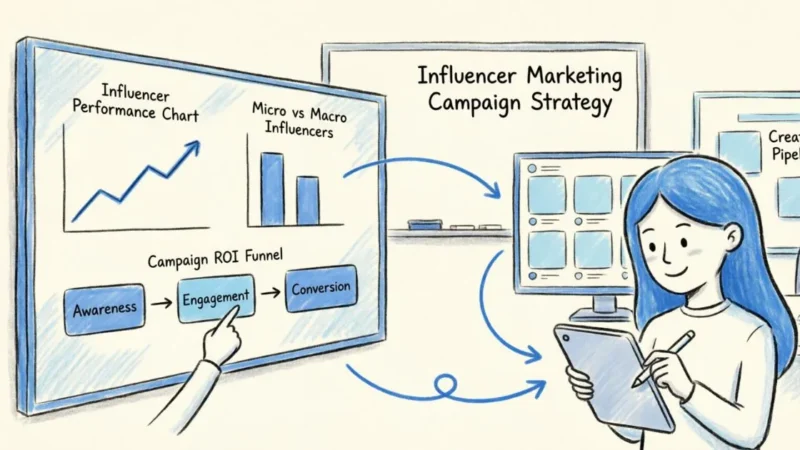
The era of the executive thought leadership article — ghostwritten, published on LinkedIn, generating polite engagement from colleagues — is ending. What’s replacing it is B2B influencer relations: genuine partnerships with independent practitioners, analysts, and community voices who have earned audience trust through years of unfiltered expertise sharing. These are not celebrities. They are the SaaS operator with 40,000 LinkedIn followers who posts daily about what’s actually working in product-led growth, or the B2B CFO with a newsletter read by 25,000 finance leaders in their sector.
Influencer Marketing Hub’s 2026 B2B report found that 78% of B2B buyers trust peer practitioner content more than vendor-produced content, and 61% have made a vendor shortlist decision based on an influencer recommendation. The marketing implication is significant: seeding your product, methodology, or perspective through respected practitioners — with genuine transparency about the relationship — drives pipeline in ways that traditional thought leadership cannot. The key distinction from consumer influencer marketing is authenticity of expertise. B2B audiences are sophisticated. They immediately recognise promotional content dressed as independent opinion. The partnerships that work are those where the influencer has used the product, genuinely endorses it, and communicates that endorsement in their own voice without brand scripts. Budget for this is now appearing as a line item in enterprise marketing plans for the first time, typically ranging from $50,000 to $500,000 annually depending on company size and sector.
4. AI Answer Engines Disrupting Organic Search
Google’s AI Overviews, Perplexity, and Microsoft Copilot are fundamentally changing how B2B buyers discover vendors. When a procurement manager searches “best enterprise CRM for manufacturing,” they increasingly receive a synthesised answer — with named vendors — rather than a list of blue links. Organic click-through rates for informational B2B queries have declined by an estimated 35% since AI overviews became default in major markets, according to BrightEdge’s 2025 Search Intelligence report. For B2B marketing teams whose pipeline relied heavily on organic search, this is an existential challenge.
The response strategy that’s emerging is optimising for AI citation rather than traditional ranking — a discipline sometimes called Answer Engine Optimisation or AEO. This means structuring content to be maximally quotable: clear definitions, specific statistics with source citations, structured data markup, FAQ schema, and authoritative external links. Brands that appear in AI-generated answers for their category’s key questions are capturing research-phase awareness that previously required paid search investment. Alongside AEO, smart B2B marketers are diversifying away from search dependency entirely — investing in community, podcast, newsletter, and direct outreach channels that are immune to search algorithm shifts. The organisations treating the AI search disruption as an opportunity to rebuild their channel mix are better positioned than those trying to optimise their way back to 2022 traffic levels.
5. Revenue Marketing — Aligning Sales and Marketing Data
The disconnect between marketing-qualified leads and actual revenue has been a persistent source of tension in B2B organisations for a decade. In 2026, the concept of revenue marketing — where marketing is measured on pipeline contribution and closed revenue rather than lead volume — has moved from aspiration to operational reality in high-performing teams. Sirius Decisions data shows that organisations with tightly aligned sales and marketing data infrastructure generate 208% more revenue from marketing activities and retain customers at 36% higher rates than misaligned peers.
The practical shift involves several interconnected changes: replacing MQL targets with pipeline contribution metrics, implementing shared CRM data visible to both functions, building attribution models that credit marketing touches across multi-month buying journeys, and establishing regular revenue reviews where marketing and sales leadership assess funnel performance together. Platforms like Clari, Gong, and 6sense are enabling this by providing unified views of account activity that combine marketing engagement data with sales conversation intelligence. The result is marketing teams that can credibly demonstrate their contribution to revenue — and adjust their investment allocation based on what’s actually generating closed deals rather than what’s generating leads that sales deprioritises. CMOs in this model become genuine revenue partners rather than cost centres, which materially changes their influence over budget and strategy.
6. Multi-Channel Buying Journeys Across 10+ Touchpoints
Gartner’s 2026 B2B Buying Study documented that the average enterprise technology purchase now involves 14.4 distinct touchpoints across the buying group before a vendor is selected. These touchpoints span vendor websites, third-party review sites like G2 and Capterra, LinkedIn content, peer referrals, webinars, sales conversations, proposal documents, legal review, and reference calls. No single channel owns the buyer. The marketing challenge is being present and consistent across all of them simultaneously — with messaging that adapts to the channel context without becoming incoherent.
The operational response is an account-based marketing approach that coordinates messaging across channels at the account level rather than the individual lead level. When a target account’s buying group shows increased G2 review browsing, LinkedIn engagement with competitor content, and multiple website visits in a thirty-day window, the right response is not a single cold email — it’s a coordinated campaign that serves relevant ads, activates a sales outreach sequence, triggers an invitation to a relevant webinar, and requests a G2 review from an existing customer contact at the account. This orchestration is now possible through platforms like Demandbase, Terminus, and HubSpot’s enterprise tier. The B2B marketers building account-level buying journey maps and coordinating channel activity around them are achieving significantly shorter sales cycles and higher win rates than those managing channels independently.
7. Vertical SaaS and Niche Community Marketing
The horizontal SaaS era — one platform for everyone — is giving way to vertical SaaS: purpose-built software for specific industries, roles, or workflows. And the marketing approach that works for vertical SaaS is fundamentally different from traditional demand generation. When your total addressable market is 12,000 veterinary practices or 8,000 independent insurance brokers, broad-reach paid advertising is wasteful. What works is deep presence within the specific professional communities your buyers inhabit — their trade associations, industry conferences, specialist media, and private Slack or Discord groups.
Niche community marketing in 2026 is a deliberate strategy rather than a secondary channel. It involves sponsoring the practitioner podcasts that your exact buyer type listens to on their commute, contributing genuine expertise to the industry forums where buying decisions are discussed informally, and building relationships with the small number of influential practitioners who set opinion in the sector. For vertical SaaS companies, a single authentic endorsement in the right community forum can generate more qualified pipeline than a month of LinkedIn advertising. The economics are dramatically better: customer acquisition costs in well-executed niche community strategies can run 60–70% below equivalent paid channel costs, and the customers acquired through community tend to retain at higher rates because they entered the funnel through trust rather than targeting.
8. Intent Data as the New Audience Targeting Layer
Third-party cookies are effectively retired across most major browsers, and the B2B marketers who relied on cookie-based retargeting have spent the last two years rebuilding their targeting infrastructure. The replacement is intent data — signals that indicate active in-market research behaviour from buyer-side organisations, captured through publisher networks, content syndication platforms, and search behaviour aggregators. Bombora, TechTarget, and G2 are among the platforms providing account-level intent signals that tell a marketer when companies in their target segment are actively researching their category.
Intent data has matured significantly. Early implementations suffered from signal quality problems and long data lag times. Current platforms provide near-real-time signals with company-level resolution — meaning a B2B marketer can see that 23 people at a specific target account have been reading content about cloud security platforms in the last two weeks, even if none of them have visited the vendor’s own website. This creates a powerful activation window: the account is demonstrably in-market, and a coordinated outreach campaign — personalised email, LinkedIn outreach, targeted advertising — launched at peak intent generates response rates three to five times higher than equivalent outreach to cold accounts. Forrester found that B2B organisations with mature intent data programmes convert target accounts to pipeline at 2.4 times the rate of those without. The investment required — typically $50,000 to $200,000 annually for enterprise-grade intent data — is generating measurable ROI for most implementations.
9. Interactive and Experience-Led Demand Generation
The B2B content formats that drove downloads in 2018 — the PDF ebook, the white paper, the webinar recording — have been commoditised beyond effectiveness. Buyers have learned to submit their email for a gated asset and immediately unsubscribe from the nurture sequence. The formats generating genuine pipeline engagement in 2026 are interactive: ROI calculators, interactive benchmarking assessments, product sandbox environments, live competitive analysis workshops, and peer roundtables where the vendor facilitates rather than presents.
Interactive content converts at dramatically higher rates than passive formats. Demand Gen Report research shows interactive assessments generate twice the conversions of static whitepapers, with the added advantage of producing first-party data about the buyer’s specific situation that personalises subsequent follow-up. A cybersecurity vendor whose lead magnet is an interactive security maturity assessment learns exactly which gaps a prospective account has — and can route them to sales with a briefing document that makes the opening conversation immediately relevant rather than generic. Experience-led demand generation events — invitation-only dinners, executive roundtables, hands-on problem-solving workshops — are similarly effective at creating the genuine relationship depth that converts to closed business in complex enterprise sales. The B2B marketers investing in interactive formats and curated experiences are building pipeline quality that volume-focused demand generation simply cannot match.
10. Trust and Transparency as a Competitive Differentiator
Enterprise buyers in 2026 are operating under procurement scrutiny, board-level data governance requirements, and regulatory pressure that makes vendor trust a material business concern rather than a soft preference. The Edelman B2B Trust Barometer found that 89% of enterprise decision-makers say they need to trust a brand before they will consider buying from them — yet only 29% describe their level of trust in technology vendors as high. This gap is a significant commercial opportunity for the minority of B2B brands willing to build trust systematically.
Trust-building in B2B marketing is operationally specific. It means publishing pricing transparently rather than behind a “contact us” barrier. It means sharing independent benchmark data that includes competitor performance rather than cherry-picking favourable comparisons. It means proactively communicating about product outages, security incidents, and roadmap changes rather than waiting to be asked. It means case studies that include specific metrics and quote real customers who will take a reference call — not anonymous “Fortune 500 company” testimonials that can’t be verified. Brands building this level of transparency are winning competitive deals against better-funded rivals whose marketing relies on claims rather than evidence. The B2B buyer of 2026 has been burned enough times to know the difference between a brand that performs trust and one that has earned it.
11. AI Influencers and Synthetic Thought Leaders
The B2B space is beginning to see the same AI influencer trend that has emerged in consumer marketing — but adapted for professional credibility requirements. Several enterprise software companies have deployed AI-generated personas as content creators: synthetic industry analysts, virtual consultants, and AI-powered subject matter experts who publish daily commentary on LinkedIn, host podcast episodes, and author newsletter editions. The economics are compelling — consistent, high-volume content publication at near-zero incremental cost, available across time zones and without the talent retention risks associated with human-dependent content strategies.
The most effective B2B AI influencer deployments are transparent about the synthetic nature of the persona while emphasising the genuine expertise embedded in its outputs — trained on proprietary research, customer data, and curated industry knowledge. Several proptech and fintech companies have launched branded AI analysts that publish sector-specific market commentary daily, generating thousands of LinkedIn followers and measurable inbound lead flow from their content. The risk in B2B specifically is audience sophistication: enterprise buyers who discover a thought leadership persona is entirely AI-generated without disclosure react negatively in ways that damage brand trust. Successful implementations maintain transparency, use AI personas to amplify human expert perspectives rather than replace them, and treat the technology as an editorial efficiency tool rather than a credibility shortcut. The brands that get this balance right are building scalable content audiences that generate pipeline. Those that get it wrong are creating reputational liabilities.
12. UGC — Customer Case Studies and Peer Reviews
User-generated content in B2B looks different from consumer UGC — it’s less TikTok dance and more LinkedIn post from a genuine customer explaining how they reduced churn by 22% using a specific platform. But the trust mechanism is identical: buyers believe other buyers far more than they believe vendors. G2’s 2026 Buyer Behaviour Report found that 92% of enterprise software buyers consult peer review platforms before shortlisting a vendor, and 72% say a negative review causes them to remove a vendor from consideration entirely. Review platform presence is no longer optional — it is a fundamental component of B2B pipeline infrastructure.
The most sophisticated B2B marketing teams have built systematic UGC programmes that treat customer content creation as a managed function rather than a spontaneous occurrence. They run quarterly customer storytelling sprints — working with customer success teams to identify recent wins, brief customers on the review and case study process, provide writing support where needed, and amplify the resulting content across LinkedIn, the company website, review platforms, and sales enablement materials. The customers who become active content contributors — speaking at events, publishing LinkedIn posts about their results, participating in community discussions — generate referral pipeline that is difficult to attribute precisely but well understood anecdotally by every sales team that has watched a prospect arrive already sold because a peer vouched for the product in a community forum. Investing in the infrastructure that makes customer storytelling easy is one of the highest-return activities in enterprise marketing.
13. Dark Social and Private Community Marketing
A growing proportion of B2B buying influence is happening in channels that are essentially invisible to standard marketing attribution: private Slack communities, Discord servers, WhatsApp groups, closed LinkedIn groups, and informal peer networks where practitioners share vendor recommendations, pricing intelligence, and product feedback without public visibility. Forrester estimates that 60–70% of B2B word-of-mouth now occurs in these dark social environments — conversations that influence purchase decisions but generate no trackable click, no UTM parameter, and no entry in the CRM. The buyer who arrives on a demo call already knowing exactly what they want to discuss has often been pre-sold by a peer in one of these communities.
Marketing into dark social is, by definition, not directly measurable — but it is cultivatable. The strategies that create positive dark social presence are: building a genuine product that practitioners want to recommend, being consistently helpful in the communities where buyers gather (without overt selling), investing in community champions who receive early access, input into roadmap decisions, and recognition in return for authentic advocacy, and creating branded private communities that become genuinely valuable to practitioners in the target market. Slack communities built around craft rather than brand — “Revenue Operations Leaders” rather than “HubSpot Users” — attract the practitioners who become the most influential dark social voices. The B2B brands that will dominate the next five years are those quietly becoming the preferred vendor in the private conversations happening right now in channels their competitors cannot see.